Wednesday, August 31, 2005

The Fetch of Mardy Watt - Charles Butler

I started reading Charles Butler's The Fetch of Mardy Watt during my half hour lunch break at work today - and finished it about an hour ago whilst a thunderstorm raged over my head (which somehow seemed appropriate !) It's a relatively short book, a little over 200 pages, but it's also rather hard to put down. I resented the fact that I had to put it aside at the end of my lunch break to continue working and I read it over dinner, putting off doing the washing up until the book was finished. In fact, I was surprised at how much I didn't want to put it down, given that I'm not very fond of supernatural books. I read Macbeth at the age of 13 and I'm not ashamed to admit that it frightened the socks off me - since then I've mostly avoided books like this one, although I was obliged to study Henry James' The Turn of the Screw during my English degree. Anyway I picked this up wondering just how spooky it would be, and was surprised it was less spooky than I had anticipated.

Synopsis: Whatever spell had been put on her was growing stronger. And suddenly, rather than fear, she felt a rush of burning anger. How dare anyone do this to her! How dare anyone steal her life!

Something is haunting Mardy Watt. It's been in her room, it's fooling her friends and it's upsetting her home life. And the trouble is, nobody realises what is happening except Mardy herself.

Exactly why the Fetch is picking on her, Mardy doesn't know – but she does know that she has to find out, before it takes over and replaces her completely.


This is something of a supernatural thriller - there is a mystery relating to why the Fetch is trying to take over Mardy's life, and just who or what is Rachel Fludd. It's also a race against time - can Mardy's best friend Hal help her to reclaim her life before she is trapped forever in her horrible half-life ? And just who is the mysterious Mayor ? I'm not going to answer these questions, because then there would be no point in you reading the book, and I strongly recommend that you do read it. Charlie Butler's books may not be exactly to my taste, but I think they deserve to be far better known than they are at present. If you don't believe me, you can download an extract in PDF from Charlie's publisher's website and read it for yourself.

Tuesday, August 30, 2005

A Lecture and a Poem

This is a combination post as I'm newly returned from my trip to Gloucestershire and too tired to think too much, so I'm going to share a news item about a forthcoming lecture and a poem which I came across today...

'Lectures for All series' at the University of Newcastle on Tuesday 27 September 2005 at 5:30 pm in Lecture Theatre 1, Herschel Building (Opposite Haymarket Metro Station)

Philip Pullman: 'Strangeness and Charm'

The first Fickling Lecture on Developments in Children's Literature, in association with Seven Stories: The Centre for Children's Books. Master storyteller Philip Pullman will look at what he calls "the elementary particles of story - the quarks and mesons and leptons and gluons and so ons of which stories are made - teasing apart the fundamental forces that hold stories together.

Philip Pullman recently shared the Astrid Lindgren Memorial Award the world's largest and most prestigious prize for children's and young people's literature - with Japanese illustrator Ryoji Arai. He will sign copies of his new book, The Scarecrow and his Servant, shortlisted for this year's Carnegie Medal, after the lecture. The lecture is free and open to all, but admission is by ticket only. Tickets are available from 12 September. For more information tel: 0191 222 6136

For general information, the Fickling Lectures will be sponsored annually by David Fickling Books (part of Random House) at the University of Newcastle. They are designed to explore the boundaries of children's literature from a variety of perspectives. David Fickling is Philip Pullman's editor and publisher and Philip Pullman is a patron of Seven Stories, The Centre for Children's Books in Newcastle, which jointly organises the series with the University of Newcastle's Children's Literature Unit. Anyone wishing to visit Seven Stories, which opened on 19 August, might like to combine that with this lecture.

I came across this poem "Dostoevsky," by Charles Bukowski (from Bone Palace Ballet © Black Sparrow Press) today and wanted to share it with you, as I thought it was an interesting expression of how one person's literary output can affect another person's life in a powerful way.

Dostoevsky

against the wall, the firing squad ready.
then he got a reprieve.
suppose they had shot Dostoevsky?
before he wrote all that?
I suppose it wouldn't have
mattered
not directly.
there are billions of people who have
never read him and never
will.
but as a young man I know that he
got me through the factories,
past the whores,
lifted me high through the night
and put me down
in a better
place.
even while in the bar
drinking with the other
derelicts,
I was glad they gave Dostoevsky a
reprieve,
it gave me one,
allowed me to look directly at those
rancid faces
in my world,
death pointing its finger,
I held fast,
an immaculate drunk
sharing the stinking dark with
my
brothers.

Monday, August 29, 2005

Northern Storm - Juliet E McKenna

Whilst it is not wholly necessary to have read Juliet E McKenna's The Swordsman's Oath in order to understand or enjoy Southern Fire and Northern Storm, there is no doubt that there is an added layer of interest to both of these later books for the reader who is familiar with the 'Tales of Einarinn'.

The novels Southern Fire and Northern Storm take the brief background of The Swordsman's Oath and add colour, depth, life and history in greater measure. They also show the reader the Archipelago from a native's point of view, instead of from an outsider's viewpoint, and this naturally gives the reader a different perspective on many aspects of life in the Archipelago, particularly the hatred of elemental magic that is felt by the Aldabreshin. Indeed one only has to consider the chaos caused by the wizard Azazir (who is regarded as a madman even by his fellow mages) in The Thief's Gamble, to understand that the disrupting influence of elemental magic on the patterns of nature would be abhorrent to the Warlords who read portents in earth, air, fire and water in order to guide the lives of themselves and their people.

The chief protagonist of Southern Fire and Northern Storm is an Aldabreshin Warlord, and Northern Storm opens with Chazen Kheda (formerly Daish Kheda) still struggling to come to terms with his forced assumption of the role of Warlord of the Chazen domain after the abrupt death from food poisoning suffered by Chazen Saril half a year ago.

Kheda is initially engaged in an attempt to round up the last of the barbarian savages who, the year before, had come from somewhere in the southern ocean to wreak havoc with a different sort of elemental magic to that used on the mainland to the north of the Archipelago. Kheda had been forced into an uneasy alliance with the unscrupulous northern mage, Dev (who had briefly appeared in The Swordsman's Oath as an agent of the Archmage). Dev is now acting (with the emphasis on 'acting') as Kheda's personal slave/bodyguard in order to ensure he gets paid for his assistance in getting rid of the savage wizards who had accompanied the southern invaders, and he and Kheda are visiting the pearl beds of the Chazen domain in order to assess what they will have to barter for the materials and goods that they need to continue the rebuilding of the Chazen domain.

Their plans to round up the last of the surviving savages and get back to normal life are abruptly interrupted by the arrival of a dragon created from elemental magic, a beast that has never before been seen in the Archipelago. Kheda thus finds himself and his domain under threat for a second time, and once again he is forced into an uneasy, but necessary, alliance with a northern mage in order to defeat and destroy the dragon. This time, however, the mage is a woman named Velindre (a character who briefly appeared in The Warrior's Bond) whom Dev suggests may know how to deal with the dragon.

Velindre knows that her mentor Otrick knew how to summon an elemental dragon, but he is dead, so she is forced to seek out Azazir (who also has this ability) in order to acquire the necessary magical knowledge to create a dragon of her own. Lest anyone think this mere altruism on the part of Velindre, who knows that if her nature is revealed she will killed to save the Archipelago from her corrupting influence, it should be pointed out that Velindre is still smarting from being passed over for the post of Cloud Mistress (Otrick's position before his death), and she hopes that mastering this magic will force Planir and the wizards on the ruling Council in Hadrumal to acknowledge that they picked the wrong mage for the job.

Northern Storm is an intriguing, even at times exciting, tale that grips the reader from start to finish, and possesses a twist to the tale that has surprised more than one reader. The only qualm I have about the Aldabreshin Compass quartet (and it is a very small one), is that the pattern of the tales seems to be closely following the pattern of the 'Tales of Einarinn': magic-wielding invaders from a previously forgotten/unknown land across the ocean arrive to cause death and destruction. There is a hint at the end of Northern Storm that, as in The Assassin's Edge (the final Tale of Einarinn), the fight will be taken to the invaders in an attempt to curtail their activities. However, the characters and their development, and the way of life that is under threat are sufficiently different and interesting in themselves, and the writing is more than sufficiently good enough, for this similarity to be of small importance in the development of the series.

[This review, in a slightly different form, first appeared on the Alien Online website.]

Sunday, August 28, 2005

Southern Fire - Juliet E McKenna

Juliet E McKenna’s Southern Fire is the first book in a series of a four, "The Aldabreshin Compass". It is set in the same world as the "Tales of Einarinn" series, this time in the Aldabreshin Archipelago where much of the story of McKenna’s second novel, The Swordsman’s Oath took place, but further to the south than we have ventured before. In Southern Fire, Daish Kheda, the warlord of the Daish domain, finds himself facing the worst possible foes, wildmen encouraged by magic-wielders. Such wizards are unknown in the southern reaches of the Archipelago, so far from the wizard-infested unbroken lands that lie close to the northern domains. The wizard-led savages have come out of the southern ocean, where no one believed anything existed, and Daish, as near neighbour to the beset Chazen domain, finds himself compelled to find some way of fighting back against the magic. He heads north across the Archipelago until he reaches the domain of Shek Khul, where he learns that Khul had been forced to deal with northern magic some three years earlier (as detailed in The Swordsman’s Oath). Shek Khul gives him a paste that is known to inhibit the powers of wizards and advises him to locate a man named Dev, whom Khul believes to be involved with wizardry, if he is not a barbarian wizard himself. Kheda manages to locate Dev, with the aid of Rhisala, a poet from the Shek domain, who is far more than she seems. Together they persuade Dev to assist them in dealing with the southern threat to the Archipelago, but having seen off the last of the wildmen, and killed off their wizard leaders, Kheda finds himself rejected by his first wife because of his involvement with magic; she encourages him to become warlord of the Chazen domain, after the sudden death of Chazen Saril from food poisoning. Janne Daish is not a woman to be argued with when she sets her mind to something, and so Daish Kheda unexpectedly finds himself obliged to turn his back on his three wives and their children, to take up the role of Chazen Kheda instead. Little does Kheda know, however, that he has not seen the last of the wildmen and wizards of the south...

Saturday, August 27, 2005

Maggie Furey's 'Artefacts of Power' series - reprise

I finished this "Sword and Sorcery" series last night. Maggie Furey’s ‘Artefacts of Power’ series features four Artefacts, one for each of the four elements. The grail (made from a fragment of the Cauldron of Rebirth) uses water to resurrect the dead, the Staff of Earth, the Harp of Winds and the Sword of Flame. These four Artefacts are wielded by different Magefolk who, at the outset of the story, are few in number – and even fewer in number by its end. Miathan, the Archmage, is slain, but as he’s more of a Saruman than a Gandalf, he’s no loss. Eliseth the Weather Mage wrests power from Miathan and wreaks even greater havoc with the grail of Rebirth than did Miathan, for she uses it to restore and control those whom she has slain, making them into puppets who do her bidding. Meriel the Healer goes mad when her soulmate is killed and causes the deaths of quite a few people before being killed herself. Davorshan tries to kill his half-brother D’Arvan, but is killed himself by his brother. D’Arvan discovers he is half-Mage and half-Phaerie and finds himself ruling the city of Nexis to protect it from the depredations of his father, the Lord of the Phaerie. Finbarr the Archivist is killed protecting others from the creatures which Miathan looses from the grail of Rebirth; the Nihilim (as their name suggests) leave their victims dead – they’re clearly ancestors of the Dementors. Bragar the Fire Mage is sacrificed by Eliseth to protect herself. Eilin the Earth Mage lives far from Nexis in a self-imposed exile after her husband is led to his death by the machinations of Miathan. Only Eilin’s daughter, Aurian, and her soulmate Anvar (who is half-Mage and half-Mortal, and Miathan’s unacknowledged son) accompanied by disparate groups of Mortals and a couple of telepathic great cats manage to successfully oppose both Miathan and Eliseth.

Aurian wields the Staff of Earth, whilst Anvar wields the Harp of Winds, both are powerful artefacts of the old high magic, like the grail of Rebirth. Aurian attempts to claim the Sword of Flame, for she has discovered that she is the One for whom it was created, but in order to claim and wield it, she must bond to it via the blood of a loved one, and she refuses to do so. Eliseth seizes the Sword, only to discover she cannot wield it and it is not until the final battle with Eliseth (after Miathan has been killed), that Aurian is able to claim it. Her first lover, Forral, was killed by Miathan’s Nihilim and as a consequence of actions of Eliseth, his spirit comes to inhabit Anvar’s body (Anvar’s spirit is inhabiting the body of a hawk). He uses the Sword to kill Anvar and bond it to Aurian, who is then able to use the grail of Rebirth to resurrect Anvar, after she has killed Eliseth with the Sword. Once Aurian has used to the grail to resurrect various people who have been killed, she gives it to Death to take to his realm, knowing that it is far too dangerous to leave it in her world where it might fall into the wrong hands in the future. She returns the Sword of Flame to the dragons who created it, being repulsed by its power for destruction, but she and Anvar continue to wield the Staff of Earth and the Harp of Winds, both of which have power for good.

Reading this series is akin to reading The Lord of the Rings, both use changing points of view and narratives that follow different groups of characters, and both move backwards and forwards across large landscapes. In addition, whilst there is one key character whose destiny will affect the future of the whole world. Furey’s characters are well-drawn and realistic in their behaviour and motivations, and I found myself caring about even the “minor” characters. I highly recommend this series (Aurian, Harp of Winds, The Sword of Flame and Dhiammara) if you like the "Sword & Sorcery" style of fantasy.

Friday, August 26, 2005

News

Just a brief note here - since theoretically I'm on holiday - I've been awarded a grant from the SF Foundation, which will enable me to travel to the University of Liverpool and spend a few days in the library accessing the SF Collection. If I can arrange some time off from work, I hope to go up in mid-to-late September - this means I'll be able to read some of the novels I've got on my reading list for a couple of my forthcoming writing projects. This, of course, is hugely helpful as I've been struggling to find some books I wanted to read (although I'm still stuck for access to Suzy McKee Charnas' The Bronze King and its 2 sequels - doesn't anyone possess this trilogy ? (Perhaps all copies have fallen into L-Space ?) Anyway I'm very grateful to the SFF - and hope to repay their generosity in due course.

Thursday, August 25, 2005

Home to Gloucestershire

Though I was not born in Gloucestershire (like my brother) and though I no longer live there, for me going to Gloucestershire is going home. I love Oxford, have done ever since I first visited it to look at the old Polytechnic (now Oxford Brookes University), but Gloucestershire's hills are home to me because I spent so many years living there (from age 7 - 19 and then from age 22 - 33). So, going back there is definitely going home - and so I am off home for 5 days, to stay with my parents and brother over the long weekend (Monday is a public holiday here).

In anticipation of this visit, I'm currently listening to a Johnny Coppin album, The Gloucestershire Collection, which features the poems of various Gloucestershire poets set to music composed by Johnny. The album caught my attention because the opening song is 'In Flanders' by F W Harvey. Now my first specialisation (if you will) was the poetry of the First World War, so the song made a lot of sense to me. This is the poem:

In Flanders

I'm homesick for my hills again -
My hills again!
To see above the Severn plain,
Unscabbarded against the sky,
The blue high blade of Cotswold lie;
The giant clouds go royally
By jagged Malvern with a train
Of shadows. Where the land is low
Like a huge imprisoning O
I hear a heart that's sound and high,
I hear the heart within me cry:
"I'm homesick for my hills again -
My hills again!
Cotswold or Malvern, sun or rain!
My hills again!"


As you see, the poem is called 'In Flanders', but it's actually about the Gloucestershire countryside - which I know well. The album is full of similar pieces, full of love for the Gloucestershire & Cotswolds countryside, much of it written by poets long dead, who nevertheless manage to speak down the years to me in a very direct way. F W Harvey was a prisoner of war for 2 years during the First World War, but he managed to survive and lived until 1957, and continued to write poetry , mostly about his beloved Gloucestershire. Harvey's poems, like those of his friend and fellow poet, Ivor Gurney, are favourites of mine, and The Gloucestershire Collection CD is one that gets played whenever I'm missing my Gloucestershire hills - or, as now, in anticipation of a visit to them.

Wednesday, August 24, 2005

Buried in Books

As a continuation, of sorts, to my post yesterday, someone sent this article from the LA Times to the Child_Lit list, where we've been having a discussion about owning lots of books, and I thought I'd share it with all you bibliophiles and bookaholics !

For me, most of these problems aren't the issue - I simply don't have the space in this tiny attic, for hundreds of books - both my bookcases are overflowing, and the tower of books I was talking about yesterday actually sits atop the 2-ring cooker (there's a tin cover over the ring so the books aren't sitting on a dirty cooker !) There's a smaller pile, consisting of the three Watcher's Guides to Buffy, and a half a dozen other books, including my current read(s) alongside the computer, atop the cupboard which also holds the microwave (which gets used very rarely). Someone, when I mentioned the pile on top of the cooker recently, asked how I cooked dinner. Which earned the blankest of looks from me, and then response "I put them on the bed out of the way, and then move them back after I've done the washing up and the cooker has cooled down." (Seems perfectly logical to me) Of course this revelation caused jokes about "cooking the books" - and will probably earn me frowns from some folks, but when your living space is a tiny 8 * 10 foot room that's not even a rectangle and features sloping ceilings on which you bang your head if you stand up without moving sideways, there's not a lot you can do ! If anyone has a spare mansion they want to let me live in rent-free, apply here ! In the meantime, I juggle books about in order to live my life with my (relatively mild) obsession - at least I use my public library a lot, which saves me having even more books I can't house...

Tuesday, August 23, 2005

Tower of Books

I keep this pile of library books in my room - it's my pending pile - actually, it's more of a tower at the moment as I've some fairly hefty hardbacks in the pile. Aside from the handful on the Vale of White Horse that are background reading for my forthcoming piece for the Tolkien Encyclopaedia, I've also got Dhiammara, the fourth and final book of Maggie Furey's fascinating Artefacts of Power series: I'll Blog the series once I've finished reading it, as I'm too engrossed to be coherent at the moment. Then there's Diana Wynne Jones' Fire and Hemlock, the September Child_Lit 'group read' book. Gwyneth Jones' Bold as Love, which I'm feeling uncertain about since the title sounds rather romantic to me ! This is followed by Raymond Feist's Faerie Tale - someone recently recommended Feist to me and this appears to be a standalone novel, so I thought I'd give it a try. Below that is the epic-looking To Ride Hell's Chasm by Janny Wurts - her books caught my eye somewhere (although I don't recall where I saw them prior to picking up that one in the library !) At the bottom of the library pile is Sarah Micklem's Firethorn, another random pick-up at the library. Aside from this Tower of library books - and I'm still waiting on Troll Mill, the sequel to Katherine Langrish's Troll Fell, which has been "in transit" through the library system for so long I'm beginning to think they've sent it on the back of a snail ! - I have three books that I own that are waiting to be read: Cornelia Funke's Inkheart, the Mercedes Lackey trilogy 'Queen's Own' (thanks to the generosity of Suzi !) and finally, Charlie Butler's The Fetch of Mardy Watt. I suspect the latter will be somewhat supernatural, but I like Charlie, so I'm going to give it a go anyway (that sounds dreadful, but I don't mean it in a nasty way - I'm just not very keen on supernatural books - but Charlie may convert me yet !)

And of course, aside from that Pisa-ish pile of books, Juliet E McKenna's Western Shore is out at the end of next week so I shall be rushing out to get a copy - although before I read it, I'll need to re-read Southern Fire and Northern Storm, to remind myself of the little details I've forgotten in my immersion in other books !

Monday, August 22, 2005

Books at any hour


I love this idea that the Parisians have come up - it's a "Livre à toute heure" or a book-at-any-hour machine. Five of the have been installed in various locations across Paris, and they contain a selection of 25 books from Homer's Odyssey and Lewis Caroll's Alice in Wonderland, to 100 Delicious Couscous Recipes and The Wok Cookbook, the latter, together with a French-English dictionary, is apparently a top seller, and Baudelaire's Les Fleurs du Mal is also popular. (I confess my mind is boggling at the thought of 100 recipes features CousCous - but that's another story !). All the books sell for just 2 Euros (about £1.35 or $2.45)

The first thing I thought of, when I read this story, was Jasper Fforde and his "Will Speak" machines (an animatronic bust of William Shakespeare that recites a famous portion of a play, such as Hamlet's 'To be or not to be' speech)... Apparently these book vending machines also exist in the US, but the Parisian ones have one major advantage over the American ones - the former don't drop the book into a slot, they deploy a mechanical arm that offers the book to the purchaser, which seems far less philistine somehow...

Sunday, August 21, 2005

P-CON III

Well, well, this is my 50th post - and frankly I'm amazed I've managed to post 50 days in a row ! There have been days when I've been preparing to sit down and write, and I've wondered what I was going to talk about until my fingers hit the keyboard... With so many books (and other Blogs) to read and so many other demands on my time outside of my writing, I wasn't convinced I would manage to post 5 times, let alone 50, but here I am...

Anyway, enough of that. I wanted to give notice of a Convention next spring which people might want to attend, if they can get to Dublin in mid-March. The Con is The Phoenix Convention, or P-CON for short, and it's a science fiction, fantasy, and horror convention, with an emphasis towards the literary ends of the genres. P-CON III, the third Phoenix Convention, will be taking place at the Ashling Hotel, Parkgate St, Dublin 8 on March 11 & 12, 2006. The guests include: Susanna Clarke (Guest of Honour and Hugo 2005 winner for Jonathan Strange & Mr Norrell), Paul Cornell (author of numerous SF/F TV related books as well as some SF fiction, and a genuinely nice bloke), Diane Duane (author of the Young Wizards (TM) series, amongst others), Maggie Furey (whose intriguing 'Artefacts of Powers' series I'm almost half-way through reading), Paul Kearney Ian McDonald Juliet E McKenna (whose books I never seem to stop recommending to fantasy fans everywhere !), Colin Smythe (Terry Pratchett's first publisher and now his agent), and others.

Details on how to join and where to stay are available on the P-CON III website. I'm hoping to go myself, but attendance will depend on whether or not I can find better paid employment before then (or buying a winning Lotto ticket, and frankly, I might as well save the £1 a week and use that money towards the cost of attending !)

Saturday, August 20, 2005

Forthcoming Films

I'm vaguely looking forward to the new Harry Potter film in November - having had mixed reactions to the first three (I hated the first two, but was happier with the third, although there were still bits that annoyed me), but some of the stills pictures I've seen look good - and the teaser poster is very tantalising !

And I'm very much looking forward to Serenity the big screen outing of Joss Whedon's shockingly short-lived Firefly series. The Great God Joss (as he's affectionately known by me, if no one else !) is the creator/writer/director of three fantastic TV shows: Firefly had a short-lived existence on American TV before the network bosses totally lost the plot and cancelled the show (sorry, but Joss writes ratings winners, the only explanation for their actions is that they lost the plot !); Buffy the Vampire Slayer on the other hand ran for an amazing seven years, and its spin-off Angel ran for five years. I came to Buffy late - it was the summer of 2002 and I was mostly out of work and I had read an article on the show in The Indepedent newspaper that made the show sound as if it was worth watching. I knew my brother was a fan and had the first season (at least) on tape, so I watched some, and got totally hooked. Buffy was a hero after my own heart - a committed and feisty young woman who despite being a warrior, had a caring heart. I was less sure about watching Angel because I hadn't found the character that interesting or likeable in the three seasons he appeared on Buffy, but I finally gave in last summer and watched all 5 seasons and enjoyed them (although I've yet to rush out and buy them as I did with Buffy !) When I heard that Joss was doing Firefly, I wasn't too sure about watching it - I'm not really that much of a Science Fiction fan, but I was persuaded (again) to try it, and again got hooked. The great thing about Joss' creations is that his charaters are utterly believeable, and I end up caring about them - which is what the best writers do, create characters whom you believe and care about... There's no doubt in my mind that Firefly could have run and run, like Buffy and Angel before it, but those TV execs couldn't recognise a good thing when they saw it. I just hope someone likes the Serenity movie enough to commission a second season for Firefly. I'll be keeping my fingers crossed !

Friday, August 19, 2005

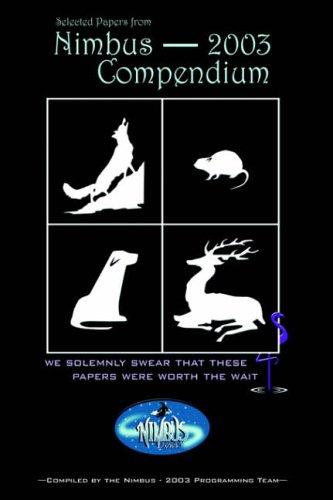
Nimbus-2003 Proceedings


Finally, after 2 years of waiting, the Nimbus-2003 Harry Potter Conference (at which my paper Harry Potter: A Universal Hero ? was presented) Proceedings are in print !

If you want to purchase it, the Selected Papers from Nimbus-2003 Compendium: We Solemnly Swear These Papers Were Worth The Wait is available in paperback or hardback from Amazon.co.uk, or from Amazon.com, also in paperback or hardback.

My paper is included in the selection, to my delight, so something I've written is now in a book (as opposed to being in a journal)...

[Edit: Heidi Tandy, one of the HPEF team responsible for Nimbus-2003, tells me that the Table of Contents for this collection is now available over at Amazon.co.uk, if you want to see what's included.]

Thursday, August 18, 2005

The Tyranny of Reading

Hester Lacey has an interesting piece in the Guardian newspaper today from which I shall quote the most thought-provoking bits (the full article in linked in the subject of this post):

So Victoria Beckham has never read a book in her life. [...] Since when did a regular quota of suitably serious reading matter become obligatory? And who decides what's worthy anyway? If Victoria Beckham swallowed a regular dose of sugary chick lit or violent slasher chillers, for example (well, they're books too), would it somehow make her reading habits more acceptable than the fact that she happens to "love fashion magazines"? [...] If you love reading, which I happen to, life without books is unthinkable; that's very true. [...] But if you don't love reading, and particularly if you positively dislike it, why should you feel in the least bit bothered if you don't polish off a serious novel a week? [...] I am quite prepared to believe that some people don't "get" books, in the same way that I don't "get" maths, or crossword puzzles, or Sudoku (which seems to be a hideous combination of two of my least favourite things, more akin to torture than fun). I can see that these are perfectly valid ways to spend time and exercise the mind. But while other people enjoy them, they leave me at best indifferent or perplexed, at worst bored to tears. Why shouldn't others feel the same way about wading through a novel or a biography or a history book? [...] Reading must be about the only pastime that is pretty much universally seen as "good" and virtuous - so to say openly that you don't like books puts you beyond the pale. For someone to say they don't care for reading labels them as some kind of thickie pariah, fair game for any insult. To decide any such thing on the basis of one single trait seems both sweeping and snobbish.

I have to say that I sympathise with Lacey over Sudoku (or Soducko as I keep deliberately mispronouncing it, with the emphasis on the first syllable !) And whilst I certainly cannot imagine a life without books, I quite understand that not everyone's as mad about books as I am... One person's meat is, after all, another person's poison - and if we all liked the same things, the world would be a very dull place indeed. Neither of my parents are avid readers - yet they have shelves full of books in their home, my Dad taught me to read so early I can't recall learning and he bought me books before I was even born. I don't despise them for preferring other past times to reading - after all they managed to bring up three voracious readers (myself and my two siblings) who've all continued to be avid readers (and writers - both my sibs write fan fic.) as adults.

Of course, the people who think reading is good and virtuous are the same kind of people who look down on fans of popular fiction authors (eg. Tolkien or Rowling), because those aren't "real" books. In their eyes that kind of popularity is cult-ish and a "bad thing". Personally I can't understand all the fuss about Dan Brown's The Da Vinci Code, I was sufficiently bored after the first chapter not to want to read any more, but I don't despise his fans, particuarly as I know that the intense enjoyment of such a book can sometimes lead readers to discover new interests (the actual art works of Da Vinci, or in history, etc.) - but if it doesn't, that's quite OK. As the saying goes, it takes all sorts...

Wednesday, August 17, 2005

Maggie Furey's 'Artefacts of Power' series

I have started picking up fantasy books at random in the library - this is safer than picking up books at random in the bookshops, since I can easily take books back to the library unread (sorry, Diane Duane, but your talking cats didn't do anything for me !) and without having spent £6+ of my hard earned cash. Fortunately it is, more often than not, a useful practice. I've picked up quite a few books at random that led me to reading an entire series: Jan Siegal's Prospero's Children and its sequels was one such book that turned out very nicely indeed. Another book that is promising is Maggie Furey's Aurian. In fact, it's proving to be useful background reading for two forthcoming writing projects, as well as interesting reading in its own right ! The Magefolk live apart from the Mortals, and it is not the done thing for a Mage and a Mortal to mate, but Aurian is about to break the rules with swordsman Forral. Which will lead to more trouble than she can imagine since the Archmage had his eye on her for his own consort. Mages don't have children very often because it leads to a loss of power for the woman during pregnancy (an interesting twist if ever there was one), so the Magefolk are a dwindling race, but Archmage Miathan dreams of restoring them to their former glory, with himself as ruler of the whole world. I've only read 10 chapters so far, but Miathan is a character begging to get his comedownance (in other words, to be brought to the worst possible place he can go to) - he's a murdering, power-crazed old man and I just know he's got to come to a nasty end. If he doesn't I shall be really upset with Maggie Furey.

Aurian is the first of a quartet of books, The Artefacts of Power series. The sequels are Harp of Winds, The Sword of Flame and Dhiammara.

Oh, and a word about the links you'll find in my posts - I'm an Amazon associate, which means that any books you purchase following the links provided on my Blog will earn me a small percentage of the purchase price, and at the end of each quarter, if I've earned more than the minimum (£10 at Amazon.co.uk), I receive a gift certificate. Whilst I'm not urging you to buy from Amazon, if you do, you'll be doing me a small favour ! (I earn such a small amount that it took me 6 months to earn more than the minimum during the year-to-date, so I'm not exactly going to be making a fortune.) I plan, once I've got some other things sorted out, to create a Scholar's Blog "bookshop" which will be hosted on my regular website. It will include links to books about authors as well, such as books of criticism or biography.

Tuesday, August 16, 2005

Fantasy series

Fantasy is famous for its mult-part series, starting with Tolkien and progressing to the likes of Robert Jordan's seemingly endless Wheel of Time series or Raymond Feist's prolific output, not to mention the 7 part Harry Potter series, Philip Pullman's His Dark Materials or Ursula Le Guin's Earthsea quartet in 6 or 7 parts (depending on whether you could the Tales from Earthsea short story collection as part of the series). This is fine, if you enjoy reading about the same group of characters in a specific "world", but what happens if you start a series and you find you can't get into one of the books ? Do you abandon it, unresolved (assuming that the writer was working towards a definite resolution) ? Or do you plough on regardless, because you're committed to the characters ?

This has only happened to me once. I read Lian Hearn's Across the Nightingale Floor (Book 1 of the 'Tales of the Otori'), and I really enjoyed it, so I was eager to read the sequel. But Grass for His Pillow bored me - I couldn't finish it and I never got as far as reading the final book in the series, Brilliance of the Moon. I was disappointed, although I don't blame the author for my inability to finish the series - somehow it just didn't work for me after the first book. I felt bad about abandoning the series part way through reading it, but I just didn't feel I could face making myself finish it.

On the other hand, I've read both The Amulet of Samarkand and its sequel Golem's Eye, by Jonathan Stroud, and I can hardly wait for the publication of the final book in the trilogy, Ptolemy's Gate which comes out in the autumn in the UK. And as anyone who has been reading my Blog lately will know, I'm a big fan of the Keys to the Kingdom series by Garth Nix, and April 2006 seems a very long way off before Sir Thursday becomes available in the UK !

For anyone who is interested in a fantasy writer's thoughts on writing trilogies/series, I recommend Juliet E McKenna's article, Deity of Choice, Not Another Bloody Fantasy Trilogy ?, which I found both interesting and thoughtful.

Monday, August 15, 2005

Destiny and Morality

I have found a further twist on the choosing one's path/accepting one's destiny dichotomy. In Garth Nix's The Keys to the Kingdom series, Arthur Penhaligon has been chosen to be the Rightful Heir to the Keys to the Kingdom, which encompasses the House of the Architect, and all her creations, including the Secondary Realms of which Arthur's Earth is just one. Arthur is forced to defeat Mister Monday in the first book, and in doing so gains mastery of the Lower House. He is then expected to go on and defeat the remaining Morrow Days, the men and women who hold the remaining 6 Keys, but he refuses to do so. He negotiates with Dame Primus and gets her to agree that he can return to Earth for another 5 or 6 years, until he's legally an adult, and then he will return to be the Master. It is interesting that, having accepted the call to be the hero, he then refuses to maintain the role (and he doesn't think of himself as a hero, either). In Grim Tuesday, the second book of the series, he is annoyed when Dame Primus contacts him and insists that he returns to the House again, House time and Earth time being totally different, Arthur has only been home for a few hours, but 6 months have passed since the events in Mister Monday. Unfortunately Arthur has to act to prevent Grim Tuesday from destroying Arthur himself and his family, not to mention the House and possibly even the multiverse. So once again he answers the call to action, but reluctantly.

Arthur is unusual since heroes, once they are chosen, usually accept the role that has been thrust upon them, and they get on with the task they have been given to do. Arthur, however, is not only a reluctant hero at the outset, he continues to feel reluctant to accept the responsibilities of his role. In this respect he reminds me of Buffy the Vampire Slayer at various points in her career as the Slayer. She wanted to refuse her role and responsibilities, even though she knew that there was no one else to fulfil it. On the other hand, she twice died to save the world and then was brought back to life - something that no other Slayer had ever done. Which leaves me wondering how things will turn out for Arthur. It's clear that he has to defeat each of the Morrow Days in turn in order to acquire their Keys, but once he has done so, will he accept his role and its responsibilities ? Particularly since hardly any Earth time is passing between his trips to the House - although 14 months of House time pass between the events recorded in Grim Tuesday and those in Drowned Wednesday. Will he be allowed his 5 or 6 years to grow up between defeating Lord Sunday and taking up his Mastery of the House ? I note that Arthur does his best each time he is faced with gaining a Key, and he doesn't just do it for himself, but to help and/or protect others, and once he has been thrown into the task, he is never half-hearted in his attempts to acquire the Key.

With regard to defeating the Morrow Days, I note that Arthur doesn't kill any of them, despite their attempts to kill him in the course of preventing him from taking their individual Keys. He chooses to show mercy to Mister Monday and restores him to his former self (although quite what that means in the long term, we have yet to be told). Grim Tuesday is put to work - initially repainting and rehabilitating the Far Reaches - although again we have not heard of him since the events in the book named after him. Lady Wednesday is a slightly different case, however; she has become a monstrous white whale 126 miles long and 32 miles wide, with a mouth that is two miles high and ten miles wide when open. She was afflicted by sorcery and becomes this shape as a result of her actions in breaking up the Will of the Architect (which it is Arthur's task to recover in its 7 component parts and reunite into a whole). However, after about two thousand years, she realises that she can no longer control her monstrous appetite or the Border Sea of which she is the Mistress. She chooses to ask Arthur to find her part of the Will, which had been wrested from her by Superior Saturday and the other Morrow Days (except Mister Monday), so that she can be returned to her rightful form and no longer be afflicted by her uncontrollable appetite. Arthur recovers the third part of the Will and Lady Wednesday gives him the Key, but she has been poisoned by Nothing (the non-matter/anti-matter - Nix hasn't really explained the physics of it) out of which the Architect created the House and its environs, and the Secondary Realms, and she dies rather than survives. It will be interesting to discover whether any of the Morrow Days are killed, or whether Arthur is able to defeat them without killing them, since killing the bad guys is usually acceptable in the fights between Good and Evil in literature.

Sunday, August 14, 2005

Ursula Le Guin & Garth Nix: a reprise

I finished reading Ursula Le Guin's Changing Planes yesterday, which I mentioned here on Friday. It's an odd book, but only in the way that any thought-provoking book is odd - and it is a very thought-provoking book. The piece, 'The Royals of Hegn' seemed amazingly perceptive, given it's written by a non-Briton - I don't meant that in a condescending/patronising way; I'm totally impressed at how perceptive the piece is as a look at the way the Royal family is treated by certain parts of the British populace. 'Wake Island' is a reminder that sleep is a very important part of our lives, and that without it, we will eventually become non-functional. 'Great Joy' was actually quite scary and a definite indictment of American corporate exploitation. The interesting thing about this book is that I assumed it was a science fiction book, but in fact it is an SF, that is Speculative Fiction, book that is leaning towards fantasy. Le Guin has created several secondary worlds and written about them, concentrating on a particular aspect of each that highlights modern preoccupations with wealth, power, control, exploitation, environmental issues, war, etc. I cannot recommend this book highly enough. Even if you're not a big fan of fantasy, science fiction or SF, do read it - it's worth making an effort to read it (as I had to do initially) because it is so thought provoking. (If you click on the link at the top of this post, you can buy it from Amazon.co.uk, or you can get it from Amazon.com. Now I've read this book, I want to read The Wave in the Mind.

After finishing Changing Planes, I started (and indeed finished) re-reading Garth Nix's Mister Monday. I had concluded, after reading Drowned Wednesday, that I could not remember enough of the details of the first two books to fully enjoy the third. I'm now part of the way through Grim Tuesday, and look forward to re-reading the third book with the first two fresh in my mind ! One thing I had forgotten was just how much fun Nix has with the concept of the Denizens of the House recording every last detail of everything that happens in the House itself or out in the "Secondary Realms" (ie the multiverse outside the House). And I love the idea of a character who used to work as a human thesaurus and who, when he's nervous, offers 6 variations on a word in a sentence, such as "Don't worry, I'm not a snitch, tattletale, dobber, blabberer, squealer, fink, or, indeed, easy-mouth [...]" !
Saturday, August 13, 2005

Reader and Critic

I've noticed that people who are passionate readers and don't know me, or don't know me very well, often regard me with some suspicion when I mention that I write lit. crit. or literary anaylsis as I prefer to call it... Criticism has such incredibly negative connotations, that I've begun avoiding the term myself, in order to deflect some of the suspicion. I am not interested in wirting negatively about books - if I don't like a book then I certainly don't want to waste my time writing about it, when I don't need to (ie. there's no one obliging me to write a review or a college essay). I'd much rather write about what interests me in a book/series - and I like to compare and contrast books by different authors, such as looking at the different ways authors have created and written about the use of magic in their works, or looking for the influence of one writer on another. Of course, such comparative analysis, if I am to do it properly (and I'm not interested in doing it half-heartedly), requires much re-reading and copious note-taking, so that I sometimes worry that I'm so busy analysing books, I am no longer simply reading and enjoying them.

Fortunately my brain seems to work on two levels when reading - what I call my inner 6 year old and my inner critic. Sometimes the inner 6 year old takes over completely - she snatches up the book and reads furiously until it's finished, determined to find out "what happens next" - and the inner critic has to wait until she's done reading and calmed down, before taking another look at the book and noticing that actually, the book isn't that original or clever or witty as the 6 year old thought - after all, the 6 year old isn't versed in themes, archetypes, tropes and all the rest of the literary critical paraphenalia that the critic understands. Equally, it is occasionally the case that the inner critic takes over and the 6 year old hardly gets a look at the book, before the critic is ruminating and analysing. The best situation is when the inner critic reads to the 6 year old: when that happens, the 6 year old gets to find out what happens next, and at the same time, the critic is observing use or subversion of themes, archetypes, tropes, etc. I hope this doesn't sound pompous or crazy - I'm not talking about a split personality here, this is just a metaphor for my ability to read on two levels simultaneously.

What I always tell people who are intimidated by the idea of talking to someone who writes literary anaylses, though, is that I am, first and foremost, a passionate bibliophile - I love books, and I am quite certain that I will always be a reader more than I am a critic. For the best part of 30 years, in spite of doing an English o-level (the public exam one took at the age of 16 back when I was 16 - these days they're called GCSEs), I was a reader. It's only since I did my degree, which I started at the age of 30, that I developed my skills of literary analysis to the point where I can spot the themes, tropes and archetypes in books. But, just like so many other Harry Potter fans, I couldn't wait to read Harry Potter and the Half Blood Prince when it came out, and I was desperate to find out "what happens next". If I enjoy a book/series enough to write about it, then you can be sure I care about the characters almost as much as if they were real people, not fictional people trapped in the pages of a book. This is what I tell people, in greater or lesser detail, when they puzzle over my status as a writer of non-fiction... Hopefully it makes them feel less suspicious - certainly they go on to have conversations about favourite books with me, so I imagine it does help.

Friday, August 12, 2005

Odd, Surreal and Ambiguous Books

I seem to have read rather a lot of ambiguous, or even downright surreal, books so far this year. First there was the frankly scary Timon's Tide by Charles Butler, which I read early this year and didn't dare to read before bed in case it gave me dreams. In it Daniel's elder brother was drowned six years ago and his body was found near the Bristol docks, bound with plastic cords. Or was it ? It seems unlikely as there is no doubt that the down-and-out who accosts Daniel in the street is in fact Timon. Daniel is 16 and has a complicated family life, so he is already finding things difficult before his brother reappears. This a relatively short story which moves quickly towards a dramatic conclusion that sweeps up the whole of Daniel's family.

Then there was the somewhat surreal Susanna Clarke's Jonathan Strange and Mr Norrell which I read shortly after Timon's Tide. This 800 page novel is set in the early 19th century, and the action moves between the genteel drawing rooms (admittedly a mischievous Faerie king sips tea with the wife of a very human government minister in some of them), to the bloody battlegrounds of Waterloo, where magically-created giant hands of earth drag men to their doom. The apposition of a perfectly realised magical world with the everyday one has been successfully created by both Philip Pullman and J K Rowling (amongst others) and the social comedy of Austen and Thackeray are easy to recognise, but it is not so easy to pastiche the ability of these writers to induce sheer narrative pleasure. Clarke succeeds with this strange yet compelling book.

A little later in the year I finally got around to reading Diana Wynne Jones' rather ambiguous book Fire and Hemlock, in which it is difficult to know where fiction ends and reality begins. This is a fantasy story that spans nine years. There is a photograph of fire and hemlock above Polly's bed which sparks memories in her that she can't quite seem to find. Nine years ago, at Halloween she accidentally gatecrashed a funeral party at the big house in the village. There she met Thomas Lynn for the first time and in spite of the fact that he is an adult and she is a child, they immediately become friends. They begin to make up absurd stories together, in which Tom is a great hero, and Polly his assistant. However, these adventures have a habit of coming true. Now, however, Tom seems to have been erased from Polly's mind, and from the rest of the world as well. During the course of the book Polly uncovers the truth and at Halloween nine years after she first met Tom, she realises that his soul is forfeit to demonic powers unless she can save him. We are going to do a "group read" and discussion of Fire and Hemlock on Child_Lit during September and if anyone is interested in participating, you can subscribe to this international email discussion list at the Child_Lit website.

The Fairy Feller's Master Stroke by Mark Chadbourn is an award winning short story which I read in the Spring and found rather surreal. Hanging in the Tate Gallery in London is a mysterious painting that captures the imagination of nearly everyone who sees it. It was painted by an artist who was later consigned to the infamous lunatic asylum, Bedlam, after he killed his father. The painting is mystical, enthralling and disconcerting; it purports to be a vista on to fairyland itself. In every aspect, The Fairy Feller's Master-Stroke is an enigma.

But for Danny, Chadbourn's elusive protagonist, it is a key to life and death, magic and wonder, hope and salvation. A former child prodigy, Danny has been obsessed with the painting all his life, and he knows it the key to a mystery about his mother, so Danny sets out on a quest into the life of Richard Dadd. By following in Dadd's footsteps to Egypt, where he first went insane, Danny himself risks madness, but the prize is worth it. But the question remain: is The Fairy Feller's Master-Stroke really a gateway to the wondrous land of Faerie that has haunted mankind's dreams for centuries, or is it something much, much darker?

This book is available from PS Publishing. Whilst you're there, check out Juliet E McKenna's short story collection, Turns and Chances, which I can recommend as a good introduction to her Tales of Einarinn series.

Then this week I've read Neil Gaiman's collection Smoke and Mirrors, which contains 36 of Gaiman's favourite stories, prose poems, and verse pieces. This contains some stories and poems I found odd, surreal or ambiguous. Amongst them are a murder mystery set among angels in heaven; the discovery of the Holy Grail in an Oxfam shop (a marvellous piece which I really enjoyed); some variations on vampirism; a firm of contract killers with a very remarkable discount scheme; Beowulf retold as a Baywatch episode; an odd amalgamation of computers and black magic; and, in the introduction, a rather grim wedding present of a manuscript that tells a bleak and different story of the recipients' unfolding marriage, which I found very disturbing.

Finally, I am currently reading Ursula Le Guin's Changing Planes which is Armchair Travel for the Mind: "It was Sita Dulip who discovered, whilst stuck in an airport, unable to get anywhere, how to change planes - literally. By a mere kind of a twist and a slipping bend, easier to do than describe, she could go anywhere - be anywhere - because she was already between planes... One day, on the way back from her sister's wedding, she missed her plane in Chicago and found herself in Choom. Le Guin, armed with this knowledge and Rornan's invaluable Handy Planetary Guide which, though it is not the Encyclopedia Planeria (which runs to forty-four rather non-portable volumes) has spent many happy years exploring places as diverse as Islac and the Veksian plane. It's touted as being a combination of Douglas Adams' The Hitch Hiker's Guide to the Galaxy and Jonathan Swift's Gulliver's Travels. I'm not too sure about it as yet, being rather more familiar with Earthsea than anything Le Guin has written in the Science Fiction genre, but I'll see how I get on with it.