Saturday, December 09, 2006

The End of Harry Potter? - David Langford

A little while ago, Kelly of Big A, little a reported that David Langford's The End of Harry Potter was the prize in a Guardian/Waterstones competition to guess the name of the final Harry Potter novel. David kindly sent me a copy of his book to read and review.

The book, I'm happy to report is full of Langford's trademark wit and sense of humour, but it has its serious moments too. He looks at such questions as "What are the remaining Horcruxes, the places He Who Shall Not Be Named has stashed his soul so he can never die?", "Does Harry himself bear a part of the Dark Lord's soul in his scar?", "Is that why Harry understands Parseltongue - and if not, why does he speak the language of the serpentssss?", "What will happen when Harry is technically a grown-up, and no longer under the protection of his Uncle Vernon and Aunt Petunia?", "Is Albus Dumbledore really dead?", "Whose side is Severus Snape really on?" and "What will the last book be called?"

Langford also takes a serious look at such things as the use of Memory Charms on Muggles, the use of Mandrakes in Herbology, and the prejudices of pure-blood wizards, and he discusses the place of the Harry Potter series in various children's literature traditions.

Probably my favourite (and by far the funniest) chapter is called "The End of Harry Potter" (no question mark) in which Langford offers some parodies of other famous tales - thus, "The Classic Fantasy Version" sees Harry and Neville set out for the "Cracks of Doom at the Pyramids of Furmat in the Dark Lord's own realm, the Land of Voldemordor, where the Shadows lie". They are followed by Kreacher, the house-elf of the Black family. Harry is about to throw the final Horcrux (the RAB locket) into the "Cracks of Doom" but then changes his mind saying he's "Basically too nice" and it's down to Kreacher to send the locket (and himself) into the fire... We also have "Professor Trelawney Predicts" (which is full of Sybil's bizarre predictions for Harry's death), "On the Cutting-Room Floor" (in which Voldemort, the Darth Lord, tells Harry he is Harry's father !), and the "Parseltongue Proclamation" which begins: Sssssssssssssss. ! After which Langford offers a few serious comments about what Harry will definitely or probably do - turn 17, go to Privet Drive, attend Bill and Fleur's wedding, find the remaining Horcruxes, etc.

This is a good book, an interesting mix of the funny/silly and the serious, and comes highly recommended.

Friday, December 08, 2006

Poetry Friday 27


Yesterday saw a tornado in North London - probably for the first time in recorded history, so I'm sticking with the weather theme again this week !

The Wind Is Without There and Howls in the Trees

The wind is without there and howls in the trees,
And the rain-flurries drum on the glass:
Alone by the fireside with elbows on knees
I can number the hours as they pass.
Yet now, when to cheer me the crickets begin,
And my pipe is just happily lit,
Believe me, my friend, tho' the evening draws in,
That not all uncontested I sit.

Alone, did I say? O no, nowise alone
With the Past sitting warm on my knee,
To gossip of days that are over and gone,
But still charming to her and to me.
With much to be glad of and much to deplore,
Yet, as these days with those we compare,
Believe me, my friend, tho' the sorrows seem more
They are somehow more easy to bear.

And thou, faded Future, uncertain and frail,
As I cherish thy light in each draught,
His lamp is not more to the miner - their sail
Is not more to the crew on the raft.
For Hope can make feeble ones earnest and brave,
And, as forth thro' the years I look on,
Believe me, my friend, between this and the grave,
I see wonderful things to be done.

To do or to try; and, believe me, my friend,
If the call should come early for me,
I can leave these foundations uprooted, and tend
For some new city over the sea.
To do or to try; and if failure be mine,
And if Fortune go cross to my plan,
Believe me, my friend, tho' I mourn the design
I shall never lament for the man.


Robert Louis Stevenson.


A Poem for the Wind

Guess who it is.
Created before the Flood.
A creature strong,
without flesh, without bone,
without veins, without blood,
without head and without feet.
It will not be older, it will not be younger,
than it was in the beginning.
There will not come from his design
fear or death.
He has no wants
from creatures.
Great God! the sea whitens
when it comes from the beginning.
Great his beauties,
the one that made him.
He in the field, he in the wood,
without hand and without foot.
Without old age, without age.
Without the most jealous destiny
and he is coeval
with the five periods of the five ages.
And also is older,
though there be five hundred thousand years.
And he is as wide
as the face of the earth,
and he was not born,
and he has not been seen.
He on sea, he on land,
he sees not, he is not seen.
He is not sincere,
he will not come when it is wished.
He on land, he on sea,
he is indispensable,
he is unconfined,
he is unequal.
He from four regions,
he will not be according to counsel.
He commences his journey
from above the stone of marble.
He is loud-voiced, he is mute.
He is uncourteous.
He is vehement, he is bold,
when he glances over the land.
He is mute, he is loud-voiced.
He is blustering.
Greatest his banner
on the face of the earth.
He is good, he is bad,
he is not bright,
he is not manifest,
for the sight does not see him.
He is bad, he is good.
He is yonder, he is here,
he will disorder.
He will not repair what he does
and be sinless.
He is wet, he is dry,
he comes frequently
from the heat of the sun and the coldness of the moon.


Taliesin

Thursday, December 07, 2006

A Recently Discovered Old English Poem

This will interest Tolkien fans. An American medievalist and folklorist named Carl Anderson has been translating Tolkien into Old English and the Old English alliterative poem is then retranslated back into more or less modern English. Tolkien fans are quite astonishing !

Wednesday, December 06, 2006

The Silver Sequence - Cliff McNish

Cliff McNish's Silver Sequence consists of three books: The Silver Child, Silver City and Silver World. Silver City is a Cybil nomination, but as I cannot bear to read series books out of sequence, I borrowed the first and third books from the library so that I could read the whole sequence.

The Silver Child

Six children leave the comfort of their homes as they find themselves drawn to Coldharbour - an eerie wasteland of wind, rats, seagulls and rubbish tips. The twins Emily and Freda, scuttle around, bright-eyed and insect-like on their toes and fingertips. They find Thomas, a rich kid, on a food tip. Then they are joined by the gentle giant Walter, who is 12 feet tall and 5 feet wide, and Helen, who suddenly discovers she can read minds. These five help a boy named Milo, who eats and eats and eats, until Thomas, with his "beauty", an unspecified power that can transform children, helps Milo to transform himself into a gigantic winged silver boy, so massive that he can cover the whole of the Coldharbour area with his body and outstretched wings. Why are these children being transformed in this way ? Because a powerful creature that the children name the Roar (because they first become aware of it only as a roaring noise) is coming to our world, intending to feed on all its life. It is centuries old and was once part of a team of assassins that helped to kill the Protectors who looked after the different worlds across the universe, but the Protector for our world is missing, presumed dead. After his transformation Milo calls all the children of the world to Coldharbour to help learn to defend the earth against the Roar.

Silver City

Milo, now transformed into a luminous silver child, keeps watch over the teeming city of Coldharbour, which is being filled with children from all over the world. Thomas, Helen, Walter and the twins Emily and Freda are doing their best to prepare themselves and the other children for the coming of the Roar. Thomas uses his beauty to transform Tanni, Parminder and a group of 198 other children into the terrifying Unearthers, children who develop drills instead of hands and then metallic bodies. But who is controlling the Unearthers, why are they draining Thomas of his beauty and why can Helen no longer hear Thomas' thoughts ? Milo's 5 year old sister, Jenny, turns up in Coldharbour following his great call. She wants to be with Thomas but cannot explain why... And then Emily and Freda discover that our world's Protector is not dead after all, but merely imprisoned deep beneath the sea. They visit it and work to free it from its prison. Meanwhile Helen is learning things from reading the mind of the Roar, and discovers that she has left an offspring buried deep in the Earth's core, below Coldharbour.

Silver World

In the third and final book of the Silver Sequence, the Roar finally arrives at our world. Milo is the first line of the Earth’s defence against her and sheltered by his wings, Helen probes the mind of the Roar, desperate to find a weakness that will allow the children to be victorious in their battle against her. Meanwhile the twins, Emily and Freda, together with a large group of other children touched by Thomas' beauty, are deep below the sea, struggling to free the Protector, which is half-blind and desperately weak following its last battle with the Roar and her offspring, Carnac. Whilst the Roar is approaching from space, Carnac is crawling from the depths of the Earth, intending to assist his mother in a two-pronged attack. Only the 200 children, known as the Unearthers, who are led by Tanni, stand in his way.

And all this time, little Jenny is calling the birds, insects and animals of the world to her to help the children defend Earth. The children's parents remain outside Coldharbour, kept out by an invisible barrier that no one over the age of 18 can pass.

Then Thomas discovers that Jenny can use his beauty to become a weapon against the Roar, and it becomes even more urgent that Helen find the Roar's weaknesses, if they are to overcome her.

This is an astonishing series. McNish takes some apparently ordinary children and makes them extraordinary and then gives them a Herculean task that it's never certain they will accomplish.

Tuesday, December 05, 2006

Raven's Gate; Evil Star - Anthony Horowitz

When I read Anthony Horowitz's Raven's Gate last October, I didn't think a great deal of it as you can see from my review at the time. However, I have just re-read it in preparation for reading the Cybils-nominated Evil Star, and I found myself more impressed with it the second time round.

Raven's Gate

Matthew Freeman is 14 and an orphan. His parents were killed in a car crash when he was 8 years old and after that he went to live with his mother's half-sister and her partner; they only took him in for the sake of the money his parents had left him, which they then proceeded to spend like water, and once it was gone, they resented his presence. As a result of their neglect, Matt drifted into petty crime: stealing things from shops, truanting from school, etc. Then Matt agrees to go with his 17 year old "friend" Kelvin to rob a warehouse full of DVDs, CDs, MP3 players, mobile phones, etc. which Kelvin's older brother Charlie had told him about; Charlie also told Kelvin that there was no security system and only one old guard at the warehouse. Unfortunately, whilst they break in easily enough, things go wrong soon afterwards, and Matt finds himself arrested as an accessory to Kelvin's attempted murder of the security guard and the attempted burglary. Since he's too young to go to prison, Matt is offered the chance to volunteer for the LEAF project: Liberty and Education Achieved through Fostering - a typical government initiative that's more about massaging the figures for juvenile delinquents being kept in custody than it is about helping said young delinquents. Matt finds himself fostered by a Mrs Deverill, who is in fact single and lives in Lesser Malling, a small Yorkshire village. She is also a witch and she knows about Matt's past, in particular the fact that he has precognitive powers, which was discovered after he dreamt about the fatal car crash that killed his parents the night before it happened. They were going to a wedding in Oxford and Matt was meant to be going too, but he pretends to be ill and gets left at home with a neighbour. Matt doesn't tell his parents why he doesn't want to go with them to the wedding, because he knew his father, who is a doctor, will be cross that Matt is talking "superstitious nonsense".

Knowing about Matt's power, Mrs Deverill is convinced that Matt is one of the Five - a group of four boys and one girl who possess great Power to fight and defeat the Old Ones who are attempt to return to the world from which they were banished by a trick several centuries ago. She intends that Matt will be the human sacrifice for Roodmas, when she and the other villagers of Lesser Malling will bring one of the Old Ones through the Raven's Gate, which used to be marked by a stone circle in the woods near Lesser Malling, but is now under the site of a prototype nuclear power station. Matt is aware that something is going on in the woods near Mrs Deverill's farm, but he doesn't know what exactly. A farmer who lives near Greater Malling attempts to help Matt, but he is murdered, although his murder is covered up by the villagers from Lesser Malling. Then one of the policemen who dealt with Matt after his arrest and during his acceptance into the LEAF project, visits Matt and seeing the state of the Deverill farm, and that Matt is looking unhealthy and overworked (and isn't attending school), he promises to get Matt away from Mrs Deverill. However, he's involved in a fatal accident on the motorway (instigated by Mrs Deverill and others) before he can put in his report.

Matt then tells his story to a local journalist named Richard Cole, who only half believes him, but just happens to be driving past the woods one night just before Roodmas when Matt is spying on the villagers in an attempt to find out more. Matt is spotted and has to escape across the moorland, but falls into a bog. Richard manages to rescue Matt and takes him back to his flat in York, but they both end up at Raven's Gate, after they go to see Professor Sanjay Dravid, who knows about the Five, the Old Ones and Raven's Gate. He belongs to a secret organisation called Nexus and they try to help Matt, but in the end, Matt is the only one who can help himself, and save the world from Raven's Gate.

Evil Star

Raven's Gate has been closed and Matt Freeman has helped to keep the world safe, but his victory is short lived. He may have thought his time with the Nexus was over and that he could go back to a more normal life afterwards, having been placed in the legal care of Richard and enrolled at a private school, but nothing is going right. Richard is living in York but commuting to Leeds for work on a newspaper there and he has little time to shop or cook. And school is nightmarish. Matt doesn't fit into the posh private school that is so different to his old comprehensive, where he was doing badly anyway, and missing several months of schooling whilst he was living with Mrs Deverill certainly hasn't helped. He's being tormented by bullies and is considering re-joining the LEAF project in the hope of finding a proper foster family. However, his old foster mother, Gwenda (half-sister to his dead mother), is about to arrive on the scene and change Matt's life even more dramatically when she, controlled by someone involved with the Old Ones, drives a full petrol tanker into the school in an attempt to kill him. Fortunately, Matt has a vision of the event just minutes before it happens and he saves himself and the school. Soon afterwards the Nexus comes gets in touch again. There is a new threat and it's related to a 16th century diary that's turned up again.

Saint Joseph, the Mad Monk of Cordoba, wrote a diary that foretold many events to come between his time and ours. The diary had been lost for a long time, but it has been found, and the Nexus believe that within its pages is the answer to the location of a second gate, somewhere in Peru. It's possible it may also contain information that would identify the other four young people who will help fight to save the world from the Old Ones. Matt is sent to meet the bookseller who bought the diary after it turned up again, but everything goes wrong since there's a traitor within the Nexus organisation. The traitor gives away the location of Matt's meeting with William Morton to Diego Salamanda, a South American businessman who also wants the diary, and he will resort to any means to get it.

Matt finds himself in Peru shortly afterwards where he meets Pedro, a poverty-stricken shoe shine boy who also happens to be another of the Five. Together they try to track down Salamanda, whilst also trying to stay alive. And they must stop Salamanda before he can open the second gate.

My only complaint about this series is the lack of female characters ! One of the Five is a girl, but so far Matt and Pedro have only seen her briefly in their dreams. Whilst Mrs Deverill was definitely a villain, she reported to a male "superior", and Gwenda Davies may have murderous tendencies when driving full fuel tankers, but she's only involved in the first few chapters of the book. There are at least two female members of the Nexus, but we don't see much of them either. Horowitz seems to write mainly for the teenage male market (given the immense popularity of the Alex Rider books with that group), and I suppose he feels they won't tolerate sympathetic female characters, which is a disappointment to this female fan.

Firefly Quote of the Week

Mal: When I want a lot of medical jargon, I'll talk to a doctor.
Simon: You are talking to a doctor.

("Objects in Space", Season 1)

Monday, December 04, 2006

Interview Juliet E McKenna

Sometimes it's not what you know, it's who you know, that lands you the plums: Interview with Juliet E McKenna.

* * * * * *

No book review today - I'm fighting off an incipient migraine and will be taking to my bed shortly.

Sunday, December 03, 2006

Wolfproof - Maureen Doyle McQuerry

Maureen Doyle McQuerry's Wolfproof is a tale full of references to British and Celtic mythology. It could easily have been written by Alan Garner, Diana Wynne Jones or Geraldine McCaughrean, but it was written by an American poet and author, and therefore its setting is American, not British. McQuerry reports that she was inspired to write the tale by seeing a carving in the roofspace of Merton College chapel (here in Oxford) of the ancient mythological figure of Greenman, with leaves sprouting from his head, vines pushing out from his mouth, and a skin made of bark.

The story is about three children: Timothy James (who is nearly 12), his older sister Sarah (who's 13 and dance-mad) and a school friend of Timothy's, Jessica. The story opens with Timothy at home with his babysitter, Mrs Clapper, whilst his parents and sister are away at a ballet audition. Mrs Clapper has warned Timothy not to open the door as he never knows what might come inside. He's of the opinion that anything that might come inside would be more interesting than watching Mrs Clapper sleeping, although he doesn't really believe anything will come inside. He decides to test his theory, and gets a big surprise when a pale man who puts light in his pockets, a girl who looks like a star, and a horned man enter his house. As a consequence of his rather rash action, a number of adventures befall the three children and they find themselves facing Herne the Hunter (the horned man) and his pack of Hounds in the midst of a wild storm, with only Mrs Clapper (who is far from all she appears to be) and her pet "dog" to assist them.


This photo shows a mediaeval wood carving of a "Green Man", one of two almost identical figures on a misericord in the parish church at Ludlow, Shropshire. This picture is in the Public Domain and the original photo was taken by Simon Garbutt.

Saturday, December 02, 2006

The Amazing Flight of Darius Frobisher - Bill Harley

Bill Harley's The Amazing Flight of Darius Frobisher is an interesting tale, albeit one with a fairly predictable fairy-tale ending. 10 year old Darius Frobisher's rather eccentric father Rudy is an insurance salesman, except when he's off on one of his adventurous journeys to Antarctica or Mongolia or in a cave somewhere with a grizzly bear. His mother is dead, so Darius is mostly brought up by Miss Hasting, the housekeeper, who makes lovely burnt toast, and will happily sit on the roof and fire water balloons at the garden.

One day, however, several weeks after Darius' father flies off in a hot air balloon and doesn't come back, Darius's carefree existence comes to an abrupt end. The legal and accounting representatives of Darius' father, Figby, Migby and Zarnoff, turn up to tell him that he is going to be sent to live with his notoriously nasty Aunt Inga, where he will be forced to sleep in a cold, damp basement. He then finds himself spending most of his waking hours trying to dodge Anthony, the horrible teenage boy next door, who's home from military school and is looking for someone to bully, and trying to keep his aunt from bemoaning his presence in her house.

Darius discovers the location of the local library, where a friendly, kindly librarian looks after him; she doesn't ask him awkward questions when he tells her that his aunt won't allow him to take the library books he's borrowed home (Inga's convinced he'll forget he has then and run up enormous fines that she'll have to pay), but instead offers him the use of an empty shelf behind the desk. Darius also meets a strange old man named Daedalus, who helps him to fix the chain on the bicycle he's rescues from his aunt's basement. He plans to use the bicycle to escape from his aunt's house to go in search of Miss Hastings. Daedalus helps Darius to refurbish the old bike, and teaches him the Greek myths, whilst Darius helps Daedalus to repair other children's bicycles. But Daedalus has a secret and when Darius discovers it, he is convinced it's just the thing to help him to escape from aunt Inga, something he becomes very desperate to do after she decides to send Darius to the same military school as Anthony.

This is a fun tale. When you're reading it, keep an eye on the bicycle illustration that decorates each right hand page from chapter 4 onwards - if you flick through the pages fast enough, you'll see the bicycle moving !

The Amazing Flight of Darius Frobisher is also available from Amazon.com.

Friday, December 01, 2006

Poetry Friday 26


It's the first of December and winter, in the form of heavy rain and strong, cold winds, seems to have arrived here with a vengeance this week, so I thought I would share some Winter-themed poems. I've known this first poem since I was a small child:

The North Wind Doth Blow

(Traditional)

The north wind doth blow,
And we shall have snow,
And what will poor robin do then,
Poor thing?
He'll sit in a barn,
And keep himself warm,
And hide his head under his wing,
Poor thing.

The north wind doth blow,
And we shall have snow,
And what will the dormouse do then,
Poor thing?
Roll'd up like a ball,
In his nest snug and small,
He'll sleep till warm weather comes in,
Poor thing.

The north wind doth blow,
And we shall have snow,
And what will the children do then,
Poor things?
When lessons are done,
They must skip hump, and run,
Until they have made themselves warm,
Poor things.


Most people know Robert Louis Stevenson as the author of Treasure Island, but did you know he also wrote poetry ? I love this one - it's so evocative of a cold winter's day:

Winter Time

(Robert Louis Stevenson)

Late lies the wintry sun a-bed,
A frosty, fiery sleepy-head;
Blinks but an hour or two; and then,
A blood-red orange, sets again.

Before the stars have left the skies,
At morning in the dark I rise;
And shivering in my nakedness,
By the cold candle, bathe and dress.

Close by the jolly fire I sit
To warm my frozen bones a bit;
Or with a reindeer-sled, explore
The colder countries round the door.

When to go out, my nurse doth wrap
Me in my comforter and cap;
The cold wind burns my face, and blows
Its frosty pepper up my nose.

Black are my steps on silver sod;
Thick blows my frosty breath abroad;
And tree and house, and hill and lake,
Are frosted like a wedding cake.


Whatever you're doing this weekend, be sure to keep warm !

* * * * * *

Edited to add: The Guardian reports that The Poetry Archive has celebrated its first anniversary today by unveiling a selection of newly-recovered historic recordings of poets from Siegfried Sassoon to Stevie Smith. Members of the Poetry Archive worked closely with staff at the BBC to retrieve the remarkable recordings, many of which were believed to have been lost forever. Sassoon, who already featured on the website reading "The Dug-Out", can now be heard reading "Everyone Sang", a poem celebrating Armistice Day which ranks among the best-known of his works. You'll find the full story of who else is included by clicking on the link above, whilst the Poetry Archive website is here.

Thursday, November 30, 2006

Into the Woods - Lyn Gardner

Lyn Gardner's Into the Woods is an interesting tale about three sisters that incorporates a host of familiar fairy tale elements (and numerous other pop culture references) that are used in interesting ways.

The story is both a quest and a rescue, although the two often merge, double up and split apart again. Aurora (almost 16), Storm and baby Anything Eden are almost-orphans (their mother died after giving birth to Anything and their father has disappeared to who-knows-where). The three live in a dilapidated manor house called Eden End. The villain of the piece is a man called Dr DeWilde, who is usually accompanied by at least half a dozen wolves and who needs a constant supply of plump children to work in the underground gemstone mine beneath Piper's Peak. His assistant in acquiring such children is a witch named Bee Bumble, who lives in rather more upmarket version of the gingerbread house. She finds children for DeWilde and fattens them up so that DeWilde can enslave them.

Storm encounters a boy named Kit, who has a splinter of ice in his heart (making him akin to Hans Christian Andersen's Kay). Kit's quest is to get his hands on a magic pipe bequeathed to Storm by her dying mother. Kit is working, sometimes reluctantly, for DeWilde - although he helps the two older girls on more than one occasion...

The girls' great-grandmother is an ogress who, in common with so many post-modern monsters (or so it appears), turns out to be completely hopeless at being bad. A key part of her job description involves eating children, but she's actually a strict vegetarian with a penchant for jelly babies (which she eats feet-first to stop them running away !), who wants nothing more than to end her days in the sunshine-filled garden of Eden End.

The key part of the story involves DeWilde's nefarious attempts to get Storm's magical pipe from her since he cannot take it from her by force without it burning him, he must either be given it freely (and with love) or win it from Storm. DeWilde is the Pied Piper and wants the pipe for himself as it contains great power - it can persuade anyone who hears it to do exactly what the player most wishes for or wants.

To accompany Gardner's intertextual tale are some funny and clever drawings by Mini Grey, for example: the illustratation of the books that DeWilde has on his shelves includes I Was a Rat by one P Pullman and the collected works of Browning !

This book, if it is about one thing in particular, is about the way in which an appetite, whether for sweets, stories, love or home, can send one off on adventures that lead, quite often, back to the place where the characters (and the reader) first started. There's a hint too, that this book may have a sequel - the words "The End" are followed by a question mark, and I'd be interested to see if Gardner could sustain the same intertextual mix for a sequel.

Into the Woods is out in the US in June 2007.

Wednesday, November 29, 2006

New Permanent Gallery for Children's Illustration

The Illustration Cupboard, Britain’s only specialist dealer in contemporary book illustration, last week opened a brand new gallery space in central London. The new space is dedicated to exhibiting and selling original artwork by more than 100 different artists, and is the first of its kind. With exhibition space on three floors, this central London gallery will display a constant and revolving programme throughout the year of single artists shows, specialist events, guest exhibitions from around the world, family afternoons and author signings.

The Illustration Cupboard provides a unique opportunity for collectors and enthusiasts to acquire original artwork by many best selling and internationally acclaimed artists, as well as the chance to purchase signed first edition books and limited edition prints. The Illustration Cupboard was established in 1995 by John Huddy, a former specialist in Old Masters who trained at Christie's, St James's, and who came to illustration through a close family connection in publishing. More and more people are appreciating the value of modern illustration both as an investment and something that can be passed from generation to generation.

The Illustration Cupboard gallery will be at 22 Bury Street, London SW1 with opening hours as follows:

Monday to Friday 10am to 6pm
Thursdays 10am to 7pm until Christmas
Saturdays 11am to 5pm until Christmas

You will find more information on the gallery's website (which is Flash enabled).

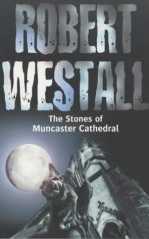
The Stones of Muncaster Cathedral - Robert Westall


Robert Westall's The Stones of Muncaster Cathedral is actually two supernatural stories in one volume. The titular tale is set in the early 1990s, and is a first-person narrative which contains a fair amount of Northern English dialect. The story is recounted by Joe Clarke, a steeplejack who agrees to work on the restoration of the southwest tower of Muncaster Cathedral. As he works, he senses in the very stonework of the tower itself, a sinister force that appears to emanate from one extra demonic-looking gargoyle. Joe's concerns are heightened when he has a nightmare about his eight year old son, Kevin, being trapped up the tower; the nightmare wakes him, screaming in his bed. The next night, Joe's fears are confirmed when Kevin sleepwalks to the tower, but is picked up by the police as he's only wearing his pyjama top. He's taken to the hospital where he's heard speaking in medieaval Latin, although he's never learnt the language, then after he wakes up, he's kept in for a few days observation. In the meantime, Joe and his mate Billy continue their work on the tower, and Joe starts digging into the history of the tower, talking to both the local museum curator and a local vicar, the Rev. Morris, whom Joe initially despises as one of the "happy-clappy" sort. Whilst Joe and Billy are working on the tower, they find the body of another little boy, and Joe realises that something really sinister is going on. He is convinced that Kevin woke up because the tower had found itself another victim.

Joe discovers that the demonic gargoyle on the south west tower looks like the master mason responsible for getting the tower built in the 14th century, and his worries persuade the vicar to do some more investigating. In the meantime, after Kevin is allowed to go home from the hospital, he attempts to go to the tower again, but this time his mum and dad manage to stop him from getting out of the house, and they tie him up and get him into the car to take him to Joe's sister-in-law in mid-Wales. Once they get Kevin across the River Severn, he comes out of his trance; Joe realises that Black Magic is at work when they start to head back home and Kevin goes back into a trance the minute they re-cross the river into England.

With Kevin safely away in Wales, Joe, together with a grumpy Detective-Sergeant named Allardyce and the Reverend Morris, goes through the cathedral's history and establishes just what Jacapo Mancini of Milan did to keep the tower up against the power of the "serpent in the sand" (an underground spring) that kept making the foundations give way as it was being built. The three of them find the knowledge that Joe needs to destroy the power of the bloodthirsty gargoyle for once and all.

The second story, Brangwyn Gardens, is set in London in 1955, where student Harry Shaftoe finds a girl's wartime diary and a photograph in the attic of his lodgings in Brangwyn Gardens. He becomes obsessed with the girl, whose diary reveals that she longs to find a dark and dangerous man somewhere in the Blitz. He convinces himself that she is dead, but he hears her talking with her friends, smells her scent in the house, and even hears the noise of the Blitz outside the house. Harry becomes mesmerised and longs to satisfy her remorseless appetite for a man, but how far can he go without being lost in the past ?

Of these two tales, the first was by far the more chilling for me, whilst I guessed reasonably early on, just what was going on in the second tale.

Tuesday, November 28, 2006

YA Author bemoans role of adults in YA fiction

The The UK SF Book News Network carries an interesting piece about the role of adults in YA novels. First time YA author, Jay Amory, comments:

"It's the adult characters! They're only there to be ignored. They introduce the young protagonist into the action then step back and play no further part, except maybe at the end. That doesn't strike me as true. Drama-wise, it helps to have your teenage heroes and heroines adrift for a while, developing their skills and learning to fend for themselves, but not for the entire book. YA authors do everything they can to remove grownups from the mix, but that, to me, hits an unrealistic note, and I prefer a bit of realism in my fantasy."

Amory finds J K Rowling's Harry Potter books, to be a prime example of this problem:
"Dumbledore is presented as this godlike, nearly omnipotent figure. He always knows what's going on. Yet in each book he leaves Harry to stumble and bumble along and get into dreadful, life-threatening scrapes for several hundred pages, then emerges at the end to resolve everything, literally with a wave of his wand. It's unfair, to say the least. He ought to pitch in right at the start. If he truly cared about Harry, he would. In fact, someone should report Dumbledore to the education board for cruelty. I'd say Harry's Muggle rights are being infringed!"

In Amory's The Fledging of Az Gabrielson, the first volume in his Clouded World series, the teen hero is in more need of help than most teen heroes.
"Az is a kid who's been born in an environment where everyone has wings … except him," Amory says. "In effect, he's disabled. He can't fly, and the sky-cities his people, the Airborn, inhabit are designed for those who can. He is looked on as a freak and somewhat resented by certain members of his race. This is the obstacle he's had to overcome all his life – until he gets recruited by the Airborn leadership for a mission, one for which he is uniquely suited. The trouble is, Az has a bit of a chip on his shoulder about his winglessness, understandably. Not only does this make him a reluctant hero, it puts him at odds with everyone around him, especially the adults."

You can read the full story at the link above.

Do readers of YA fiction agree with Amory that adults should be more involved in YA novels ? Or will it put off the readers at whom the books are marketed ?

Blog Logo

I'm toying with the idea of adding a logo to my Blog, and have come up with a couple of designs. I'd be interested to know what people think of them - do you prefer one more than the other, or just dislike them both ? The font style of the second one will look familiar to Buffy fans - it's called "Buffied" !


(I'm not quite sure why the first one is coming out so small - it's actually bigger than the second one when viewed in my photo editing program !)

Stones of Abraxas - K Osborn Sullivan

K Osborn Sullivan's Stones of Abraxas was rather disappointing. Before reading it, I had seen a review which revealed that unlike most children's quest fantasy tales, the two protagonists go off on a magical quest and their parents go too. I had high hopes that it would prove to be a subgenre-busting debut novel, but it was not to be.

David Stanhope is 12 years old and about to start the long summer vacation. He enjoys squabbling with his 14 year old sister, Amanda; they live in the suburbs of Chicago with their parents. His mother is the head librarian at his middle school and his father is the shop teacher at the high school. We're told this, and a great deal more about David, his family, friends, and neighbours in the first chapter of Stones of Abraxas, but most of the information there proves irrelevant as it's barely mentioned again, which is frustrating. Instead, whilst the children are helping their mother to find their camping gear (their father is at an out-of-town teacher's conference), in preparation for spending a month at their cottage that's badly in need of repair, they find a large ruby on a chain, which it turns out to have unexpected powers. It transports them to an alternate world, known as Abraxas, where different species control different-coloured Stones. If the Stones of Abraxas are joined with a large golden shield, then the evil magician, Adrian the Deceiver, will use them to make him invulnerable. At this point, I nearly stopped reading, Whoever heard of an evil magician named "Adrian" ? Sullivan invented some quite extraordinary names, so why not use one of them for the evil magician ? Was she trying to make the point that even the mundane can be evil ? I don't know, but I do know that I could not take seriously a bad guy named Adrian as I kept thinking of Sue Townsend's Adrian Mole !

I also could not see the point of the children's parents coming to Abraxas with them, since both of them largely ignored their children in order to attend meetings of the Shield Council, who are desperate to find ways of stopping Adrian from acquiring the Ruby, or else they reverted to their Terran selves, with Dad roaming around looking for the Abraxan equivalent of electronic bugging devices, and Mom spending hours in the library, looking for a book that explained how to destroy the Stones without destroying both the worlds. The adults are worried as it's clear there's a spy in Annwyn Castle (and the spy was flagged up so far in advance I'd have been more surprised if the person who was unmasked had been someone else), but the children are still allowed to roam around with whomever they choose and wherever they please, with the result that they nearly get themselves killed on occasion.

I realise this is Sullivan's first book (she's planning a series of five books set in this world) and that first books are rarely brilliant, but I was disappointed that it didn't live up to its potential. I've read some brilliant books this year, several of them Cybils nominations, that have gripped me from start to finish, and left me desperate for more, but this book was not one of them. Of course, I'm just one reader, and other readers may find much to enjoy in this book, so don't let my disappointment with it put you off trying it for yourself. I really hope that Sullivan's later books live up to the potential of this one.

Firefly Quote of the Week

Zoe: Sir, I know she's unpredictable, but I don't think she'd harm anyone.
Jayne: Butcher's knife!
Zoe: Anyone we can't spare.

("Objects in Space", Season 1)

Monday, November 27, 2006

The Edge of the Forest - November issue

The November edition of The Edge of the Forest is now online. Here's a quick run down of what's over there this month:

.

In addition to this, there are reviews in all categories — from Picture book to Young Adult.

The Kid Picks this month is actually Teen Picks as Little Willow talks books with some high school students.

Don't forget to subscribe to The Edge of the Forest with the Subscribe feature. Just enter your name and email address and you will receive notification of when each new issue is published.

The Edge of the Forest will return December 18 with our final issue for 2006.

My Swordhand Is Singing - Marcus Sedgwick

From the title onwards, Marcus Sedgwick's My Swordhand is Singing is a poetic tale set in the isolated, hostile environment of the forests of seventeenth century Romania. It tells the story of the woodcutter Tomas and his teenage son, Peter, who are outsiders in the village of Chust. The pair cannot seem to find a place to settle, although they have spent longer in Chust than anywhere else before, and Peter is starting to put down some roots, beginning a tentative romance with Agnes, the daughter of the draper. However, Tomas is keeping secrets from his son (such as what is hidden in the long wooden box that Tomas hides under his mattress), and strange and menacing things are happening in Chust: a man who died recently in mysterious circumstances is said to be visiting his widow at night, and she is looking pale and weak as a consequence. Something is very, very wrong in Chust.

In an author's note, Sedgwick notes that there are many old vampire legends, which all tell different stories, some of them contradicting others. In some of the legends, the undead are the fang-toothed vampires of Hammer Horror movies, whilst in others they are more like zombie flesh-eaters, and in still others they are werewolves. Sedgwick explains that My Swordhand Is Singing is inspired by all these varied and ancient Eastern European legends of vampires, and combines them them to make a new retelling.

Sedgwick writes with a concise precision that still allows for poetic expression, such as this:

There was nothing for Tomas now.
Not the singing.
Not the square.
Not the dead.
Not even Sultan.
Just the sword, that flew so fast that the air itself was cut in two.
But the hands grasped and grappled and there were too many. He was pulled from Sultan's back landing clumsily in the mud.
From a seemingly vast distance, he heard a cry.
'Father!'
Peter. It was his son, Peter, sprinting to be beside him in a moment. Dimly, Tomas saw Peter snatch the sword from the ground and begin to swing it wildly about him. The hostages [vampires] faltered, shocked by the fluid energy of the boy, by his strength.
Tomas' eyes were closed, but in his mind he could see Peter twisting and stroking the blade from side to side.
'That's it,' he whispered. 'That's it. Feel it.'
In his heart, he hread Peter's reply.
'Yes, Father. My swordhand is singing.' (pp. 187-88)

Sedgwick doesn't waste words as he paints a chilling Gothic picture of the fight between good and evil. My Swordhand Is Singing is tense, unnerving and beautifully structured so that every element is woven into the tale in a seamless manner. This tale features love, courage, regret, loss, and redemption, plus a strong dose of the supernatural. This is definitely one of the best books I've read this year.

Sunday, November 26, 2006

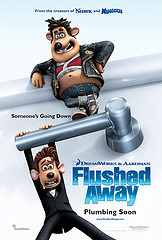
Flushed Away movie review


One of my local cinemas was previewing Flushed Away the new Aardman Animation/Dreamworks CGI movie this weekend, so I snuck away from the Cybils longlist for a couple of hours to go and catch the last preview before the film opens on Friday. And as I'd expected of the Oscar-winning Aardman, this film was a joy to see. The movie tells the story of pampered pet rat, Roddy (Hugh Jackman), who is flushed down the toilet of his palatial Kensington home by smart sewer-rat, Sid (Shane Richie) and ends up in Ratropolis. There Roddy meets Rita (Kate Winslet), an enterprising scavenger who works the sewers in her faithful boat, the Jammy Dodger. Roddy immediately wants out, or rather, up; Rita wants to be paid for her trouble; and, speaking of trouble, the villainous Toad (Ian McKellan) - who royally despises the rats - and wants them iced... literally. The Toad dispatches his two hapless hench-rats, Spike (Andy Serkis) and Whitey (Bill Nighy), to get the job done but when they fail, the Toad has no choice but to send to France for his cousin - that dreaded mercenary, Le Frog (Jean Reno).

I hardly stopped laughing from start to finish whilst watching this film. From the opening, where Roddy is looking in the wardrobe for an outfit to wear and discards a wizard's outfit (referencing The Lord of the Rings in which Ian McKellan played Gandalf), a blue and yellow shirt (worn by Wolverine, played by Hugh Jackman in the movies, in the comic), and a shirt and green knitted sleeveless sweater (as worn by Wallace in the Wallace and Gromit films made by Aardman), through the orange fish who asks Roddy: "Have you seen my Dad" (referencing Finding Nemo, made by rival animation company Pixar), to the Toad opening his freezer full of enemies and do-gooders encased in blocks of ice, including a rat dressed as Han Solo (referencing Star Wars: The Empire Strikes Back). Then there are the amazing singing slugs, who provide sound effects, spooky horror-style music, and emotional ballads as appropriate - and which promoted the last line of the credits to read "No slugs were a-salted in the making of this film."

Then there are the various chases, including one which features the Toad's hench-rats riding egg-beaters down the sewer, one of whom is stopped by a packet of Instant Whip...