Sunday, July 31, 2005

'Personal isn't the same as important'

This is a bit of Terry Pratchett philosophy. Specifically it is the philosophy of Captain Carrot Ironfoundersson who works for the Night Watch. It is a view that is first expressed, however, by Granny Weatherwax in Lords and Ladies (p. 164), where it is something of a throwaway line. Archchancellor Ridcully, to whom it is said, doesn't really react much to this rather provocative statement. The following year, Pratchett's Men at Arms came out, and it was in this book that Carrot expressed this view as his own philosophy. He is talking to Commander Vimes (ie. his boss), telling Vimes not to shoot Dr Cruces, the head of the Assassins' Guild and Vimes says:

'He killed Angua [Carrot's girlfriend]. Doesn't that mean anything to you?'
Carrot nodded.
'Yes. But personal isn't the same as important.'
(p. 358)

Vimes, understandably is a little puzzled by this comment and queries it a little later. But both Carrot and Granny Weatherwax are expressing the same idea - that their duty to the communities in which they live (Granny as a witch in Lancre and Carrot as the Discworld equivalent of a policeman in Ankh-Morpork) is of greater importance than personal relationships, particularly when those communities are in grave danger.

Carrot's philosophy is mentioned again in Jingo and again it is in the context of his relationship with Angua. In this instance Angua has been kidnapped and Vimes is again involved, only this time we hear his thoughts on Carrot's philosophy:

There was, if you didn't know Carrot, something wrong with the situation. There were people who, when their girlfriend was spirited away on a foreign ship, would have dived into the Ankh, or at least run briskly along the crust, leapt aboard and dealt out merry hell on a democratic basis. Of course, at a time like this that would be a dumb thing to do. The sensible approach would be to let people know, but even so - But Carrot really did believe that personal wasn't the same as important. Of course, Vimes believed the same thing. You had to hope that when push came to shove, you'd act the right way. But there was something slightly creepy about someone who didn't just believe it, but lived their life by it. (p. 214)

Of course, Vimes is right - the idea of duty these days is a fairly outmoded one; interestingly, however, Carrot appears to put his personal relationship with Angua before his duty to his community in The Fifth Elephant. Commander Vimes has been sent off to Uberwald on a diplomatic mission, and Captain Carrot is put in charge of the Watch in his absence. However, Carrot receives a note from Angua, then hands in his notice to the Patrician, and heads off into the wild, tracking Angua. She has left the city and headed off towards home, which also happens to be in Uberwald, to deal with her troublesome brother who, like Angua, is a werewolf. Near the end of the book Carrot confronts Angua's brother, Wolfgang, and gets into a fight during which he's badly injured. Angua reveals that she has adopted Carrot's philosophy for herself when she observes that Carrot couldn't have beaten Wolfgang in a fair fight and she says "I know he's family, but ... personal is not the same as important. Carrot always said that." (p. 266)

Of course, in the end it turns out that Carrot's actions in going after Angua have helped to solve an important crime in Uberwald, and resolved a difficult political situation, but I still found it interesting that a young man who has lived by the belief that duty should come before anything else, would neverthless resign his post (not that the Patrician accepted Carrot's resignation, he said he would treat it as an extended leave of absence since Carrot had never taken any holiday during the years he had been working in the Watch) for the sake of a personal relationship.

Carrot is a very upright, honest, moral young man. He doesn't know how to lie and on the one occasion when he had to investigate someone under cover, he felt really uncomfortable, even though he wasn't doing anything illegal. Many characters believe that he is the heir to the throne of Ankh-Morpork, but Carrot isn't interested in being a King, he's a "copper", but he has many of the qualities that considered ideal in an ideal king, such as integrity, honesty, a caring nature, an interest in everyone from the Patrician to the least important members of Ankh-Morpork society. And he knows everyone and everyone knows him.

My thanks go to my brother Scott for the quotations from Jingo and Men at Arms, neither of which I have on my bookshelves.

Saturday, July 30, 2005

The Matter of Elves

I've been re-reading Terry Pratchett's Lords and Ladies for the first time in years, and found I had forgotten just how obnoxious his elves are in comparison to Tolkien's wise and beautiful beings. Magrat Garlick, Pratchett's "wet hen" witch who is about to become the Queen of Lancre in this book, thinks of elves as being like cats - they have pointed ears and hair you want to stroke, but they're as self-centred and cruel as cats too - they enjoy playing with people or animals in a hurtful way. Although Pratchett describes his elves as being beautiful, he indicates that this is because they use a glamour to disguise their true nature from humans, so that humanity can be tricked into accepting them. The most telling part of Lords and Ladies in this respect is this:

Elves are wonderful. They provoke wonder.
Elves are marvellous. They cause marvels.
Elves are fantastic. They create fantasies.
Elves are glamorous. They project glamour.
Elves are enchanting. They weave enchantment.
Elves are terrific. They beget terror.
(L&L, pp 122-23)

As far as Pratchett is concerned, elves are not admirable, they are evil and terrifying, and one of the best ways to counteract their influence is to carry iron. Pratchett's elves, in fact, are more akin to the cradle-robbing fairies of myth than they are to the wise and immortal elves of Middle-earth. They appear to have no imagination or real emotions, so they are fascinated by children, musicians and artists.

Of course, Pratchett is not the only author to portray evil Elves: R A Salvatore wrote The Dark Elf Trilogy; there are dark elves in Dragonlance, who are guilty of various crimes and have therefore been cast out from their communities. Dark elves also feature in the Dungeons and Dragons game realm. Although not all "dark elves" are evil, they are in the majority. Tolkien also created Dark Elves, in The Silmarillion, but the term there has less to do with good and evil, and far more to do with the fact that the Dark Elves, Moriquendi, had not seen the Light of the Two Trees.

Of course, Terry Pratchett set out to parody post-Tolkienian fantasy when he created the Discworld, and in his creation of the elves he has certainly succeeded.

Friday, July 29, 2005

Charlie and the Chocolate Factory

Wow !

I have to say that despite the reviews, spoilers and interviews I've read, this film took my breath away ! The opening scenes - which I know some viewers have objected to as too menacing or high-tech, seemed to set the right tone for me. I was reminded of the manufacturing scenes from Edward Scissorhands (an earlier Burton/Depp collaboration) which I only saw for the first time a couple of months ago...

The singing puppets scene was funny - I was reminded of the singing puppets in Shrek - although I heard some small children shrieking when they started burning...

I loved the boat on the chocolate river - that was gorgeous - and the children seemed to be as obnoxious as I remembered from the book (and far more obnoxious, I felt, than in the Gene Wilder version), especially Mike Teavee ! I had to laugh at Wonka telling him not mumble just because he couldn't understand Mike's high-tech jargon !

The look of Wonka hacking through the jungle was pure Johnny Depp - he looked like an Indiana Jones-wannabe - and much better without the weird hair style and white face (although even with that look, I wasn't reminded of Michael Jackson, as so many people have been). I'm ambivalent about the Oompa-Loompas - I know it's not politically correct to portray a group of pygmy foreigners who are "imported" to work in a factory, but they provided some very funny moments - particularly when four of them did the Beatles tribute...

I loved Freddie Highmore as Charlie - that lad can really act - and I thought it was interesting that Burton & co. had Charlie suggest selling the ticket to the highest bidder because they needed the money more than he needed the chocolate. I liked the idea that he was thinking of his family's welfare, not just the benefit to himself. This seemed a stark contrast to Verucca Salt and her father instructing his factory workers to open thousands of bars of chocolate so he could get a ticket for her.

Oh and my favourite laugh out loud moments - Wonka walking into the doors of the glass elevator, not once but twice !

I didn't think the backstory of Charlie and his scary dentist father was strictly necessary, but I did enjoy seeing Christopher Lee again (it seems a long time since he played Saruman) - and I loved the fact that he had dozens of cuttings and a scrapbook recording his son's success.

All in all, I thoroughly enjoyed this film and I look forward to watching it again when the DVD comes out (although I shall need to watch it on a bigger screen than my tiny portable, to do the FX justice !)

Now I just have to find a copy of the book at the library...

Thursday, July 28, 2005

The Write Fantastic

The Write Fantastic is a group of six fantasy authors who have teamed up in order to introduce the joys of fantasy fiction to readers who have never tried the genre, and also to show those readers who have stopped reading it, the breadth and depth that is available in current fantasy writing. The 6 authors are Sarah Ash, Chaz Brenchley, Mark Chadbourn, Juliet E McKenna, Stan Nicholls and Jessica Rydill, and their work covers the whole range of fantasy from orcs and dragons, through high heroic "swords and sorcery", to the reimagining of myth and history, and the magics of matter, mind and spirit. You can catch them at various events at Interaction, the 63rd World Science Fiction Convention in Glasgow from 4th - 8th August, where they will be involved in various panels and activities. Juliet E McKenna will be talking about the 'Trilogy Middle Book Problem' and 'Subverted Elves, Hard Assed Fairies with Attitude, and Dragons Taking Tea' (with Terry Pratchett amongst others), whilst Mark Chadbourn (whose The Fairy Feller's Masterstroke wins the prize for the most surreal book I've read so far this year) will be wondering whether Tolkien's work still has relevance to young people today and 'How do you research things that don't exist?' Sarah Ash, meanwhile, will be talking about the 'British Landscape and the Fantastic'. Chaz Brenchley will discuss the 'Aesthetics of Horror Fiction', Stan Nicholls will talk about 'Mapping your World: Creating the Back Story' and wondering whether 'Tie In novels are worth it or if they stop people from reading real novels', and Jessica Rydill says 'It can't be fantasy - I like it !' These are just the highlights - or so they appear to me - of the talks and panels that these 6 authors will be doing - more information is available from the above-linked Interaction site. I want to assure you that I'm not a publicist for this group (or for Juliet E McKenna, despite my frequent mentions of her work, I just happen to think highly of her books), I just think the idea of The Write Fantastic is a good one, if it means more good fantasy books are reaching more readers, since fantasy is my favourite form of fiction.

Wednesday, July 27, 2005

New books I look forward to reading


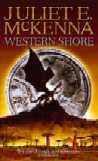
This September 1 sees the publication of the third book in a series of four by Juliet E McKenna, Western Shore. Set in the Aldabreshin Archipelego, it continues the story of warlord Daish Kheda's uneasy alliance with the barbarian Northern wizards of the unbroken lands. In the last novel, Northern Storm, Kheda and the disreputable mage Dev, overcame a dragon created from elemental magic, but the threat to the Chazen islands, over which Kheda rules, remains. In the new novel, Kheda decides to join forces with the Northern wizards again in the hope of removing the dragon threat for good. He also wants to find purification from the taint of magic that his alliance with Dev, and others of his kind, has left. This series began with Southern Fire, which itself followed on from the second book (The Swordsman's Oath) of McKenna's other series, The Tales of Einarinn. I can heartily recommend both series, and in fact I wrote a paper on McKenna's The Tales of Einarinn series earlier this year.

The other book to which I'm looking forward won't actually be out until next May (2006) in the UK. Lynn Flewelling's The Oracle's Queen is the final book in the Tamir Triad. This series began with The Bone Doll's Twin, in which the powerful wizard Iya attempted to restore the line of ruling Queens to Skala. This required disguising the new-born twin daughter of the King's sister, Ariani, as a boy, and the magically-contrived still-birth of the twin son. The story continues in Hidden Warrior in which Skala is at war with its old enemy, Plenimar, whilst plague stalks across the land, and Prince Tobin discovers that she is a girl, not a boy, as she had appeared to be until the onset of puberty began to unravel the magics that had kept her true nature hidden.

Tuesday, July 26, 2005

Following your destiny or choosing your path III

At the risk of boring everyone senseless, I've come back to this topic again and I've been thinking again today about Harry Potter and Frodo Baggins. George Clark, in his essay 'J R R Tolkien and the True Hero', mentions that Gandalf tells Frodo that he was "meant to have" the Ring and suggests that this is a comforting thought (Lord of the Rings, p. 84). Frodo retorts that it is not, and says that he isn't "made for perilous quests" (LotR, p. 91). Clark says that Frodo's question, 'Why me?', "implies [Frodo's] acceptance of the quest" (1), which is then confirmed at the Council of Elrond, when Frodo says he will take the Ring to Mordor despite the fact that he does not know the way; Frodo feels wonder at his own words, feeling "as if some other will was using his small voice" (LotR, p. 354).

In a stark contrast to this, Harry Potter set outs to thwart Lord Voldemort, to prevent him from getting the Philosopher's Stone, several years before he even learns of the existence of a Prophecy that implicates Harry in Voldemort's downfall (Philosopher's Stone, pp. 196-97). Harry chooses voluntarily over and over again to fight Voldemort, to resist his attempts to gain power over both the Wizarding and the Muggle worlds. He consciously chooses to oppose Voldemort five times before Dumbledore tells him the details of the Prophecy that was made about Harry and Voldemort. In The Philosopher's Stone he stops Professor Quirrell from getting the Philosopher's Stone for Voldemort; in The Chamber of Secrets, he stops Riddle/Voldemort from continuing to use Ginny Weasley as his agent for attacking the students; in The Prisoner of Azkaban, he stops Sirius and Lupin from becoming murderers for the sake of revenging the death of their friend (and Harry's father), James - if they had murdered Peter Pettigrew/Wormtail, they would have been no better than Voldemort himself; in The Goblet of Fire, although Harry is unable to prevent Cedric's murder or Voldemort's re-embodiment, he ensures that the one wizard of whom Voldemort has always been a little afraid, is alerted to Voldemort's return, thus ensuring that Cedric's death was not wholly in vain. He also incidentally sets Mad-Eye Moody free from nearly a year of imprisonment; and in The Order of the Phoenix, he prevents Voldemort from hearing Trelawney's prophecy in full, and exposes Voldemort's return to the previously disbelieving Minister of Magic.

It is this which makes Harry different from Frodo as a hero figure. Frodo is chosen for his quest by an outside agency (Eru, Middle-earth's Creator figure), whereas Harry has already volunteered for his quest long before he learns that he has been chosen to defeat Voldemort, and ironically, that he has been chosen by Voldemort himself. Dumbledore points out to Harry that he would have wanted to kill Voldemort, even if he had never heard the Prophecy, something which Harry ought to have realised for himself, since he had been resisting Voldemort for so long before he did hear the Prophecy. Harry realises that his choice to heed the Prophecy now he knows of it, is like choosing to walk into a battle to the death with one's head held high, which is a different thing from being dragged into a battle to the death against one's will (The Half-Blood Prince, pp. 478-79). Harry may well be the Chosen One, as he's referred to quite often by the Daily Prophet, but he has also chosen his own path.

(1) George Clark, 'J R R Tolkien and the True Hero' in J R R Tolkien and his Literary Resonances, eds. George Clark and Daniel Timmons (Greenwood Press, 2000), p. 45

Monday, July 25, 2005

Following your destiny or choosing your path II

I've been thinking further about the fact that Harry Potter chooses his own path, whilst Frodo Baggins' path is chosen for him, and I've realised that the norm in fantasy fiction is for the hero/protagonist to have their path chosen for them. In Robin McKinley's The Blue Sword, Harry Crewe finds herself living on the edge of a range of mountains near the desert after her father's death leaves her bereft of her home, which is in trust to her military brother. Harry Crewe is kidnapped by the chieftan of the people who live on the other side of the mountain range and finds herself fulfilling an unexpected role which she was destined to fulfil. In a similar vein, in Garth Nix's Sabriel, the eponymous heroine, who had been expecting to finish her schooling and head off to University, instead finds herself obliged to take over her father's role as Abhorsen, a necromancer with the power to bind the dead and prevent them from succeeding in their eternal quest to overcome all living beings.

One of the few fantasy heroines who does choose her own path is Juliet E McKenna's Livak, in The Thief's Gamble and the sequels that make up the Tales of Einarinn. Livak gets blackmailed into assisting in someone else's "treasure quest", and although she is later given opportunities to take her earnings and walk away from the dangerous life she finds herself living, she refuses to take that path. Until she was blackmailed by a bunch of wizards, she had been making a living as a full time gambler and part time thief, tramping the roads across the length and breadth of Ensaimin, and although such a life has dangers attendant on it, they are considerably less life-threatening, on the whole, than the dangers attendant on being a thief to a bunch of wizards and scholars. Livak, however, may be immoral, but she is not dishonourable, and she chooses to remain with the wizards and scholars, and to assist them in their quest. Livak is a good example of a fantasy heroine who chooses her own path, and has been doing so since her teens. In this respect, she is more akin to Harry Potter than she is to Frodo Baggins.

Sunday, July 24, 2005

Following your destiny or choosing your path

Those of you who have yet to read/finish the latest Harry Potter book might want to avoid this post as it does contain some spoilers.

I watched Whale Rider again this afternoon. This is a fabulous movie about a young Maori girl, Paikea, who is the youngest descendant of the tribe chieftan. Her twin brother dies in childbirth, and she believes it is her destiny to fulfil the role of chief when her grandfather Koro, the current chief, is no longer able to take the role. However, Koro, like any Maori chief, does not accept that a girl can be the tribe's chief, and he begins teaching the first-born sons of the tribe's other families, hoping to find his successor from amongst them. In the end, though, Paikea proves herself to be the rightful successor to Koro.

This got me thinking about the whole issue of following one's destiny or choosing one's path, in particular in relation to the Potterverse. It's quite clear that J K Rowling doesn't really believe in destiny/fate, whereas Tolkien quite clearly did. No doubt this is in part due to their individual personal beliefs; Tolkien was a lifelong Roman Catholic, so the idea of fate or someone guiding events, so that Frodo is "meant to have the Ring", is a very natural one for him. Tolkien believes in the hand of God guiding individuals. Rowling, however, does not appear to accept this; near the beginning of the Harry Potter series, Dumbledore tells Harry "It's our choices [...] that show what we truly are..." (Harry Potter and the Chamber of Secrets, p. 245 UK edition). And in the latest book, Dumbledore tells Harry that he has a choice about or not to accept the prophecy that was made: "you are free to choose your way, quite free to turn your back on the prophecy" (Harry Potter and the Half-Blood Prince, p. 479 UK edition). Of course, Voldemort is equally free to choose not to kill Harry, but it is not in his nature to make that choice. In his desperate desire to be immortal, he feels he has to kill Harry in order to avoid being killed by him.

Harry, of course, is not the only one who makes choices. At the end of Half-Blood Prince, he tells Ron and Hermione that he won't be coming back to Hogwarts the following year, even if it does re-open, because he has to find the remaining Horcruxes. Ron tells Harry that he and Hermione will go with Harry to find them. Harry starts to object, but Hermione points out that Harry had given them the choice once before, to turn back and they had not taken it, so they would not be taking it now (Harry Potter and the Half-Blood Prince, p. 607 UK edition). It is my belief that they will not be the only two to make the choice to assist Harry in his final quest. I believe that Ginny will choose to go with them, and that if they sneak off without her, she will find a way to follow them. She tells Harry that she doesn't care whether Voldemort finds out about them and tries to use her to get through Harry, but Harry has already rescued Ginny from Riddle/Voldemort's clutches once before, and he doesn't want to risk it happening again. I don't think that Ginny will be dissuaded from going with or following Harry, Ron and Hermione. Nor do I think she'll be alone in that decision as I believe Neville and Luna will go too. I have this feeling that JKR has developed Neville's character for a reason, and not just for him to play a bit part in a couple of fights with Death-Eaters. I also believe that JKR has created the friendship between Luna and that little group of Gryffindors for a reason, and that it won't end because Harry isn't going to complete his education.

Saturday, July 23, 2005

Tolkien 2005

To celebrate the 50th anniversary of the publication of The Lord of the Rings the Tolkien Society is holding a conference and convention at Aston University in Birmingham (England) from 11 to 15 August 2005. The Guest list, to me, is a Who's Who in Tolkien Scholarship:

Patrick Curry - is the author of Defending Middle-earth: Tolkien, Myth and Modernity, which has just been re-issued in the US with a new Afterword.

Colin Duriez - is the author of The Inklings Handbook (with David Porter), Tolkien and The Lord of the Rings, J.R.R. Tolkien and C.S. Lewis: The Story of their Friendship, and A Field Guide to Narnia.

Verlyn Flieger - is a professor at Maryland University and author of Splintered Light: Logos and Language in Tolkien's World, Question of Time: JRR Tolkien's Road to Faerie and Tolkien's Legendarium: Essays on The History of Middle-earth (which was co-edited with Carl Hostetter).

John Garth - is the author of Tolkien and the Great War: The Threshold of Middle-earth (a fascinating book).

Alan Lee - is an artist who is known worldwide for his many Tolkien illustrations, including the 1992 edition of The Lord of the Rings. He was, with John Howe (who will also be a guest), one of the conceptual artists for the LotR film trilogy.

Tom Shippey - is a noted Tolkien scholar and professor of philology. He is the author of The Road to Middle-earth and J R R Tolkien: Author of the Century (both of which I own.)

Brian Sibley - in conjunction with Michael Bakewell, he adapted The Lord of the Rings for the acclaimed BBC Radio 4 's dramatisation. He is also author of The Lord of the Rings: Official Movie Guide and The Lord of the Rings: The Making of the Movie Trilogy.

In addition to these illustrious guests, there will be scholarly papers presented on a number of topics, including 'Tolkien in Fiction' by Colin Duriez, 'Footsteps of the Archetypes in the Legend of LotR and RotK: End of the Psychic Journey towards the Self' by Arash Javanbakht, 'Tolkien's Mythology' by Rae Ann Kumelos, 'Hope, Sacrifice, and Courage in LotR' by Nicole Topham and 'Frodo as Primal Hero/Sacrifice' by Constance G. Wagner, which all sound very interesting to me and rather makes me wish I had bought a lottery ticket today, or that I otherwise had the cost of the registration and accommodation...

Friday, July 22, 2005

Words, words, words !

I have a major fascination with words and the English language which actually started before I started to become a serious writer. I love all sorts of language play - puns, anagrams, Scrabble, rearranging advertising slogans (eg. "Tense, nervous headache? You need Andrex!" - for those who are too young to remember the original advert or who are not familiar with the advert or the brand, it was originally "Anadin", a brand of painkiller (logically), rather than "Andrex", a brand of toilet paper !). The only thing I've never got the hang of is crosswords, strangely. Although I'm a complete pedant when it comes to English usage, I still love to play around with words: I have fun making up, or using other people's, invented words. Supercalafragalisticexpealidocious anyone ? Merely saying it slowly sounds quite atrocious - and writing it was even worse ! I went to Sweden a couple of years ago to give a Harry Potter paper, and I enjoyed trying to guess the origins of the place names I saw on the hour-long drive from the airport to the hotel where I was staying - a lot of them seemed to feature Tuna, but had nothing to do with fish !

I love onomatopoeia too - words like susurration, which is a favourite of Terry Pratchett's Tiffany Aching in The Wee Free Men. Like Tiffany I've often read the dictionary as if it were a novel, and a friend recently told me the definition of a boring person: someone who looks up a word in the dictionary and then closes the dictionary - which seemed like a good definition to me. I love words so much that I receive two daily emails which give me a Word of the Day: yourdictionary.com is one website where you can sign up for such a service, but there are dozens more online.

Part of the reason why I enjoy both Terry Pratchett's books and Harry Potter is the linguistic fun they both offer; the Discworld books are full of "punes" (as they are invariably called on the Discworld) or plays on words, and there's fun in figuring out the English meaning of J K Rowling's often Latinised names for spells and creatures. And of course, it was the magic of language development which led Tolkien to the creation of The Lord of the Rings. Not that I've any intention of trying to create my own myths - I'll leave that to those with the imagination to create fictional worlds and I'll stick to what I'm better at, writing literary criticism.

Thursday, July 21, 2005

Dragons and Turtles: Myth and Fantasy

Clearly I've been reading far too much Terry Pratchett-related material of late: Terry Pratchett: Guilty of Literature, which I mentioned here before, and Once More with Footnotes (edited by Priscilla Olson and Sheila M Perry, published by The NESFA Press, 2004), because I have been thinking about turtle-shaped holes in humanity's consciousness, and of the similar dragon-shaped holes which exist in some people's consciousness. Terry Pratchett refers, in his article Imaginary Worlds, Real Stories, to the turtle-shaped hole in humanity's consciousness:

"Most of my books, [...] are set in the largely imaginary world of Discworld. I say "largely imaginary" because of course it has that slight air of solidarity that mythology brings to an image; the idea that the world goes through space on the back of the turtle, as the Discworld does, is found in many cultures. It is either very old indeed or we just naturally have a turtle-shaped hole in our consciousness. It's most developed in Hindu mythology; I don't recall ever learning about it, it being one of those things you grow up knowing without any apparent source, but it's an image that often appears in books of popular astronomy and I suppose I must have got it from one of them when I was a child.

Pratchett has said elsewhere (and if anyone can tell me exactly where, I'd be glad to hear) that it was into this turtle-shaped hole that Discworld fell and thus a fantasy world was born, which continues to bring a great deal of pleasure and amusement to readers across the globe.

In a similar vein, J R R Tolkien, in his essay On Fairy-stories, tells the reader that "I desired dragons with a profound desire". Tolkien was entranced by Norse literature, in which Fáfnir the dragon appeared, and Beowulf, who, though he was an old man, went out to fight a dragon with his companion Wiglaf. The two of them kill the dragon, but the dragon has mortally wounded Beowulf. So Tolkien created Smaug, in The Hobbit who was slain by Bard of Esgaroth; Glaurung, Father of Dragons, who was slain by Túrin Turambar; Ancalagon the Black who was slain by Eärendil and Scatha who slain by Fram of the Éothéod.

Dragons in fantasy literature come in a variety of shapes, types and personalities, much as they do in myth. Dragons are generally accepted are typically depicted as huge lizards, that are larger than elephants and possessing horns. In Western culture they usually have large wings to enable them to fly, but in Eastern culture they are most often wingless and use magic to fly. Eastern dragons tend to be more snake-like as well, although possessing front and rear legs as does Smaug when drawn by Tolkien. The majority of dragons are described as being covered in scales, although some have a leathery skin. Most dragons have the ability to breathe fire.

I seem to have read a lot of fantasy novels that feature dragons, probably because I, too, have long "desired dragons". Terry Pratchett's dragons come in several forms, although they are all magical beasts: Twoflower creates one by the power of his imagination in The Colour of Magic and the Night Watch fight one in Guards! Guards!, whilst Lady Sybil, Commander Vimes' wife breeds swamp dragons; Juliet E McKenna's dragons are creatures of magic created from the element in which a mage is strongest (see the Aldabreshin Compass quartet); Christopher Paolini's Eragon hatches from an egg; Robin Hobb's dragons are created by the Skill magic wielded by the Farseers and other Skill users; Ursula Le Guin's dragons can also take human form, so are shape-shifters. I could go on - and no doubt others could too (I know Anne MacCaffrey writes dragon-tales, but I have never read them), but it is getting late, so I will close here.

Wednesday, July 20, 2005

Wolves & Werewolves in Fantasy Literature

The werewolf has long had a place in folklore: the man (or woman, although it is most often a man), who can transform themselves into a wolf at the full moon and can only be killed by silver arrows or bullets is an ancient symbol. It probably started with the Greek myth of Lycaon, king of Arcadia, who was notoriously cruel and tried to get Zeus' favour by offering him the flesh of a young child. In punishment, Zeus turned him into a wolf. Strangely enough the Christian church once considered it heretical not to believe in werewolves, which were deemed to be servants of Satan and the personification of evil; those who were schizophrenic, epileptic or mentally disabled were accused and tried for being werewolves (1).

My own interest in wolves has existed for many years, and has been increased by a variety of fantasy books which I have read and enjoyed. There first books were The Hobbit (featuring Wolves) and The Lord of the Rings (featuring Wargs, which have always seemed akin to wolves to me). Ironically, when I read The Silmarillion for the first time last year, I discovered that Beren had disguised himself as one of Morgoth's werewolves when he went to retrieve the Silmaril with Luthien. Wolves came up again, in the form of the werewolf/wizard Remus Lupin (was ever a name so blatant an admission of the named one's essential being ?), in Harry Potter and the Prisoner of Azkaban and the subsequent titles; and of course, in counterpoint to Lupin, in Harry Potter and the Half-Blood Prince, we see Fenrir Greyback, a Death-Eater werewolf. (Interestingly, Fenrir is a werewolf name borrowed from Norse literature, the same Norse literature that inspired so much of Tolkien's development of Middle-earth.)

Then I read Robin Hobb's Farseer trilogy and Tawny Man trilogy, and discovered a wolf by the name of Nighteyes, who is a companion to FitzChivalry Farseer and with whom Nighteyes shares his mind via a form of magic called the Wit. I found Nighteyes to be a very interesting character. He is a intelligent being who, over the years of sharing his mind with Fitz, learns to think like a man (which is not necessarily a good thing). There is the female werewolf, Angua, who is also a City Guard in Terry Pratchett's Discworld novels about the Night Watch in Ankh-Morpork and is too decent to eat people, although she's sorely tempted on occasion, and is subjected to peppermint bombs and other similar devices to prevent her from following a trail. There is also a werewolf, Lougarry, who has been trapped in her wolf form by a wizard in Jan Siegal's Prospero's Children trilogy and becomes his companion. Then today, having finished re-reading HP6 last night, I began reading The Book of Atrix Wolfe, by Patricia McKillip, and I find that Atrix Wolfe is a wizard/werewolf also. It appears that the Western world's fascination with werewolves is just as strong as it ever was, and of course the fascination is not limited to fantasy literature. There have been numerous werewolf movies too, and Joss Whedon's Buffy the Vampire Slayer TV series features a young man named Oz, whose baby cousin Jordy is a werewolf who bites Oz for tickling him, and turns him into a werewolf. Whilst in the spin-off series, Angel, a young woman named Nina is also turned into a werewolf, and features in one of the funniest episodes of Angel ever aired, 'Smile Time'.

(1) "Werewolf." Encyclopedia Mythica from
Encyclopedia Mythica Online
.

Tuesday, July 19, 2005

The Lord of the Rings 50th anniversary

All that is gold does not glitter,
Not all those who wander are lost;
The old that is strong does not wither,
Deep roots are not reached by frost.

From the ashes a fire shall be woken,
A light from the shadows shall spring;
Renewed shall be blade that was broken,
The crownless again shall be king.
(1)

For readers who are fans of Tolkien's The Lord of the Rings, today is a special day as it is the 50th anniversary of the publication of the first part of the half a million page novel. (Note it is NOT a trilogy. It was published in 3 parts at the insistence of the publishers, Allen & Unwin, in part because of post-war time paper shortages, but also because the publishers were uncertain how well it would sell.) It is the sequel to The Hobbit, which came out in 1937. Tolkien wrote The Hobbit for his own amusement and didn't expect it to sell well, but it did, in part because his friend and fellow Inkling, C. S. Lewis, reviewed it so well. As a consequence A & U asked for a sequel, but Tolkien was short of ideas, having used them all up in The Hobbit, as he told his publishers.

Tolkien spent the next 17 years working on The Lord of the Rings, in between (and sometimes instead of) his scholarly work (he was a Professor at Oxford University). He was distracted from completing what would become The Lord of the Rings, however, by his desire to work on his Elvish languages and the history of Middle-earth that would eventually be published posthumously as The Silmarillion. Finally, in the autumn of 1949, he finished The Lord of the Rings, but there were further delays because Tolkien wanted Allen & Unwin to publish both The Lord of the Rings and The Silmarillion together, but the reader's report for the latter was not promising, and A & U rejected the offer. So Tolkien offered both to Collins, but they were reluctant too, so it went to A & U after all, and on July 19 1954, The Fellowship of the Ring appeared. The first printing was just 3,500 copies, but the book turned out to be so popular that it went into a second printing after only six weeks. The second part, The Two Towers, came out in November 1954 and the final part, The Return of the King came out in October 1955, after various delays part of which were caused by Tolkien trying to sort out the Appendices he had promised to his readers. Today more than 30 million copies of The Lord of the Rings have been sold worldwide.

(1) The Fellowship of the Rings, (c)HarperCollins, 1954, 1991

[Addendum: It has come to my attention that the first part of The Fellowship of the Rings was published on July 29, 1954, not July 19 as I was told. Apologies for the misinformation.]

Monday, July 18, 2005

Will Harry kill Voldemort and other questions (Spoilers)

Yes it's another Harry Potter post, but I make no apology for that - this series is on my mind now I've read the newest book (and in fact I am still re-reading it)...

I've been wondering - and discussing with others on the Child_Lit emailing list - whether Harry will kill Voldemort in book 7. After all the prophecy does not say Harry has to kill Voldemort, it says that "either must die at the hand of the other for neither can live while the other survives. (Order of the Phoenix, p. 741) and I think that can be interpreted as Harry doing something that causes Voldemort's death, without Harry actually needing to use the Avada Kedavra curse. Perhaps Harry will choose to forgive Voldemort, who will kill himself in remorse/disgust ? Or perhaps Voldemort will fall to his death in a convenient volcano (oops, wrong universe !) ? After all, Voldemort is mortal now and therefore killable by fairly ordinary means... Perhaps Harry will lead Voldemort into the Forbidden Forest where Aragog's descendants will attack him, aided by the centaurs ? OK, I admit it, I'm being rather facetious now. But I think that makes the point that Harry doesn't necessarily need to use the worst of the Unforgivable Curses on Voldemort, especially since Dumbledore kept telling Harry that he has a power that Voldemort does not, the power to love. And killing Voldemort won't demonstrate that love, unless, of course, Harry sacrifices himself to do it.

What I've also been wondering is why Dumbledore immobilised Harry on the top of the Astronomy Tower when Draco turned up ? I think that he knew Harry would have attacked Draco, and possibly have prevented Snape from fulfilling his vow. It seems likely that Dumbledore knew of Draco's Task and Snape's Vow - presumably Snape told Dumbledore about both, and Dumbledore told him that he would sacrifice himself to protect both Draco (believing that Draco wouldn't be able to kill him) and Snape himself. That would also explain the look of revulsion on Snape's face when Harry calls him a coward - he had to kill Dumbledore or die himself, and he chose to kill Dumbledore, the man who had given him a second chance, rather than dying himself. This would also explain why Dumbledore told Harry to fetch Snape once they got back to Hogsmeade, rather than fetch Madam Pomfrey, as Harry wanted. Dumbledore knew he was dying of whatever the potion was that he'd been drinking to get at the Horcrux, so he was giving Snape a way of keeping his Vow by finishing off Dumbledore, and of protecting Draco as well. But it didn't quite work out as Dumbledore intended because Draco had set things in motion as well, setting off the Dark Mark and bringing in the Death-Eaters.

Anyway that's enough speculation for one day - I've got a book to read !

Sunday, July 17, 2005

Professor Trelawney (possible HP6 Spoilers)

After reading Harry Potter and the Half-Blood Prince yesterday, it seems to me that there is more accuracy to some of Sybill Trelawney's apparently wild predictions than many readers realise, probably because of the disdain of Professor McGonagall and Hermione, and the mockery of Harry and Ron. Aside from the obvious accuracy of Trelawney's prophecy about Harry and Voldemort, and the prediction (during Harry's Divination exam in his third year) that Peter Pettigrew will be rejoining Voldemort, there are a few other instances of Trelawney's predictions being more right than wrong.

The first of these instances comes in the very first of Harry's Divination lessons in The Prisoner of Azkaban: Professor Trelawney says that Harry has the Grim, the giant spectral dog that haunts churchyards and is an omen of death. Both Hermione and Professor McGonagall pour scorn on this, but Trelawney is not entirely inaccurate. Of course, the large dog that Harry has seen turns out to be Sirius Black in Animagus form, but there is room to interpret Trelawney's words as accurate; Sirius Black is believed to have killed a number of Muggles and a wizard, and he haunts Harry throughout much of the year.

The second instance occurs in The Goblet of Fire. In their first lesson of the year, Trelawney tells Harry that she sees past his brave front, and observes that he is preoccupied and that he faces difficult times. She also mentions that the thing he dreads will come to pass, sooner than he thinks (p. 176). Harry does not believe Trelawney, but he does face difficult times throughout the duration of the Triwizard Tournament, and he is preoccupied with concerns over Sirius' safety, whilst the latter is on the run. The thing that he dreads which comes to pass is probably the return of Voldemort - Harry's dread may have been subconscious, but I don't doubt it existed.

The third instance occurs in The Order of the Phoenix. Professor Umbridge, in her role as High Inquisitor of Hogwarts, inspects Trelawney's lesson and demands that she make a prediction. Trelawney hesitates, then tells Umbridge that she is in "grave danger" and faces something dark (p. 282). It turns out that Trelawney is right: Umbridge is endangering herself by her actions at Hogwarts, and her behaviour towards anyone whom she deems to be a "half-breed". Eventually, she insults the centaurs, who carry her off into the notoriously dark Forbidden Forest.

The fourth instance comes in The Half-Blood Prince. Harry is heading off to his first private lesson with Professor Dumbledore when he sees Professor Trelawney wandering along the corridor, reading a pack of dirty playing cards. He hides behind a statue before she sees him, and he overhears what she is saying:
"'Two of spades: conflict,' she murmured, as she passed the place where Harry crouched, hidden. 'Seven of spades: an ill omen. Ten of spades: violence. Knave of spades: a dark young man, possibly troubled, one who dislikes the questioner - '
She stopped dead, right on the other side of Harry's statue.
'Well, that can't be right,' she said, annoyed, and Harry heard he reshuffling vigorously as she set off again [. . .]'"
(p. 185)
The words "a dark young man, possibly troubled, one who dislikes the questioner" are what convinced me that Trelawney is not as fraudulent as readers have been led to believe - Harry is hiding only two or three feet away at most, he is dark haired, troubled by the Second Wizarding War, and dislikes Trelawney. Maybe there is more to Trelawney's predictions than lucky guesswork and a spooky manner. (The Goblet of Fire, p. 177)

Saturday, July 16, 2005

Harry Potter & the Half-Blood Prince - Spoilers

OK, it took me roughly six hours (discounting the "interruptions") to read it, but I've finished it. To be fair to anyone who reads this Blog but hasn't yet read or finished HP6, I will leave a large space before I start talking details. I'm not going to name the character who dies, but I am going to talk about other things that some readers might consider spoilers, so don't say you haven't been warned !!

S

P

O

I

L

E

R


S

P

A

C

E

I'm devastated about who died, I really thought Rowling would leave killing him off until nearly the end of book 7. I worked out who it was at the end of Chapter 25 - big clue in there, I feel...

I'm glad that we didn't have any more of CAPSLOCK!Harry as they called him in the HP for GrownUps group (ie. the Harry who was nearly always SHOUTING at people in The Order of the Phoenix) - and very glad that Rowling gave Harry the chance to be the Gryffindor Quidditch Captain, though I was even more glad she spared us endless descriptions of the games, despite his Captaincy (not being a sports fan, they were rather dull after a while)... I'm also very, very glad that she gave Harry the chance to spend so much time with Dumbledore this year, particularly after he spent so little time talking to Harry last year (I mean his previous year, obviously), except in that big exposition scene... I was quite glad, too, that we missed out on the big exposition scene this time - although not glad about the reason why...

I was amused that Felix Felices turned out to be a potion, not a person as so many people had believed; intrigued that Snape got the Dark Arts job finally (much good it did him !) - I've never trusted Snape - but not just because Harry didn't, I really didn't like him, although I know some HP fans who think he's lovely (just goes to show that attraction is a peculiar thing !); I'm intrigued by the fact that Draco couldn't complete his task - and wondering what will happen to him now - will Voldemort kill him before Harry catches up with him ? It's clear that Harry was totally appalled at what the Sectumsempra curse did - and that he felt a twinge of pity for Draco after Snape killed Draco's intended target...

I was pleased as punch that Harry got nearly all his OWLS after all... I think I'd predicted he wouldn't get Astronomy either, because of the exam being interrupted - but I'm glad I was wrong on that score... I am also pleased that Harry and Ginny finally got together (if only Ron and Hermione had managed it too !) although disappointed (but not surprised) that he "finished" with her at the end of term - I understand his reasoning, although I'm not sure I agree with it - after all, Ginny is becoming a very powerful young witch. I also liked the fact that it was Neville, Luna, Ginny, Hermione and Ron who got involved in trying to watch Draco and Snape - the same five DA members who went to the Ministry with him in The Order of the Phoenix, and the fact that half of that group were girls (if you include Harry in the group), just proves my contention that the critics who moaned about the girls being just giggling/shrieking wallflowers were wrong - thank you, J K Rowling, for continuing to prove me right !

Well, much material to digest ready to start writing about it in my current essay-in-progress... I shall, of course, begin re-reading it tomorrow, and start filling my copy of the book with my spidery notes... (I hasten to add that my notes will be on notepaper, not in the book - I do NOT write in books - well except to pencil in proof-reading corrections occasionally !)

Friday, July 15, 2005

Inspiring criticism

That heading can be read two ways, but I want to talk about the kind of literary criticism (or lit. crit. as it's often called) that inspires one to read the books about which the critic is talking. I've just finished reading Terry Pratchett: Guilty of Literature (1), which I mentioned here a few days ago, and it's the kind of lit. crit. I really appreciate - and that I try to write myself. The kind that inspires one to go and read (or re-read) the books under discussion, and the kind of lit. crit. that is written by people who really know the book(s) about which they're writing. When I was researching my first Harry Potter paper, it really, really annoyed me whenever I read an article by a critic who got very basic facts about the stories wrong (I'm not going to name and shame anyone, so don't ask for details !) That kind of thing doesn't inspire any trust in the critic on my part, and I tend to feel that if someone can't get even the basic facts right, then I cannot value their opinions. On the other hand, Andrew M Butler's piece 'Theories of Humour', inspired me to re-read Mort again for the first time in several years, and I paid it far greater attention this time, because I had Andrew's thoughts in my head as I read. That is good criticism and that is why I make it a rule to only write about books that I know well and that I enjoy reading, otherwise I will not do justice to the books, or their authors. I'm not interested in writing just for the sake of writing, I'm interested in writing to inspire my readers to go out and read the books I've discussed.

(1) You'll have to scroll down the page for the book's details. If you can, please do buy a copy of this book as profits go to the Science Fiction Foundation and to Terry's favourite charity, the Orangutan Foundation. Thank you.

PS. No Blog tomorrow, unless I finish HP6 earlier than I am anticipating (and, no, I'm not buying mine at midnight tonight !)

Thursday, July 14, 2005

From Book to Film

Since I mentioned a film adaptation of a book yesterday, I thought I would talk a bit about book/film adaptations I've experienced. First, a couple of films that I saw before I read the books. Having discovered the talents of Johnny Depp, I picked up Chocolat based on the novel of the same name by Joanne Harris. I thoroughly enjoyed the film (more for the performance of Judi Dench than Johnny Depp, to tell the truth since the latter is not in the film very much, and I'm a big fan of Judi Dench, who seems to steal every film she ever appears in !) and I decided to read the book, which I enjoyed. Years ago I saw the film version of Roald Dahl's Matilda before I had ever read the book - I enjoyed the film for the performances of Danny Devito and Pam Ferris, and I enjoyed the book, but not quite as much: maybe Pam Ferris' headmistress was just too scary to compete !

Being a fan of both Tolkien and Harry Potter, I've seen the film versions of The Lord of the Rings and the HP films. The first LotR film bowled me over, and although there were changes and omissions that disappointed me, I was carried away by the awesome scenery and the ensemble cast, and I decided I was prepared to cut Peter Jackson some slack and watch the other two films. The first Harry Potter film annoyed me, although not as much as the second (snake chase anyone ?). After I saw Harry Potter and the Chamber of Secrets, I swore not to watch Harry Potter and the Prisoner of Azkaban, not least because it's my favourite book of the series so far. However, a friend of a friend who was staying in Oxford for a month or so, invited me to go and see it with her, and I felt it would be churlish to refuse. I was very glad that I did not refuse as Alfonso Cuaron's vision restored my faith the HP film franchise (although it remains to be seen what any of the other directors make of it - I've heard some worrying things about the fourth film !). I had decided, during the time of watching the three LotR films, that I had to accept that films and books were two quite different mediums, and that it would be easier and probably more enjoyable if I remembered this and treated films adapted from books, and the books themselves as separate entities. It also helps if I'm not passionately attached to a particular book. I think I was accepting of the film versions of Matilda, Charlie and the Chocolate Factory (the first film of which I saw for the first time a few weeks ago), and Chocolat because I had no particular attachment to them. On the other hand, I've been reading the Lord of the Rings regularly for 20+ years and I'm very passionate about it. And Harry Potter ? Well, I'm a bit less passionate about those books, but I do know them extremely well from reading them so often in order to write papers on them !

So I will go to see the new version of Charlie with an open mind and a certain amount of interest to see what Depp and Tim Burton have made of this children's book.

Wednesday, July 13, 2005

Blogs

It's too hot here in my tiny attic room (29C which is about 84F in "old money"), to stay on the PC for long, but that's OK because I just wanted to take a few minutes to plug blogs by a couple of people I know from the Child_Lit emailing list, of which I'm a member.

The first blog is Book Moot by Camille Powell, who's a Tolkien fan, like me. I love the quote at the head of her Blog: "She is too fond of books, and it has turned her brain." from Louisa May Alcott - this could have been written about me, easily !

The second is Wayfarers All by Kerry Byrna. She's currently very enthusiastic about the forthcoming Charlie and the Chocolate Factory movie, featuring Johnny Depp and Freddie Highmore (who played Peter Llewelyn Davies in Finding Neverland).

It was the latter film that convinced me there was more to Johnny Depp than his crazy turn as Captain Jack Sparrow in Pirates of the Caribbean; not being much of a movie-goer in my youth (largely owing to living about 20 miles from the nearest cinema, having no car and little spare cash), I hadn't seen Depp in anything before I saw "Pirates". Finding Neverland really was a surprise to me, since Depp's role in it is far more straight than Jack Sparrow. So, like Kerry, I'm interested in the new adaptation of Roald Dahl's book, although being in the UK, I've got to wait another 2 weeks before I can see it ! Still, those two weeks will soon pass...

Tuesday, July 12, 2005

Summer Reading

Summer reading, for me, is something of a misnomer since I don't go away on holiday and I read continuously all year round, and always have done; my father taught me to read at such an early age that I have no recollection of ever not being able to read. However, I do (at least over the last few years) go in for special reading projects during the summer: last year it was the works of J R R Tolkien, and in particular The History of Middle-earth series. This sprang out of a lengthy period of researching and writing two consecutive papers on Tolkien: 'The Enduring Popularity and Influence of The Lord of the Rings' in The British Science Fiction Association journal, Vector (May/June 2004) and 'The Influence of Tolkien and The Lord of the Rings on Women Fantasy Authors' in Tolkien Society Annual Seminar 2004 Proceedings (which has not actually been published yet, so far as I know). I had preceded reading HoME (as it's known) with The Lord of the Rings and The Silmarillion, and followed it by reading (amongst others), The Unfinished Tales and Tales from the Perilous Realm (which includes Farmer Giles of Ham and Smith of Wootton Major as well as other short stories). This summer however, having rather overwhelmed myself with Tolkien (I might almost say overdosed !) last year, I am following two strands of reading - one purely for pleasure (which is probably what most people think summer reading should be about !) and the other is background reading - and a bit of "foreground" reading too, since I will be reading Harry Potter and the Half-Blood Prince on Saturday, and I will Blog it within 24 hours of finishing it, so if you don't want to run the risk of a spoiler (and I can't promise not to mention who dies, but I will try not to do so), you might want to avoid my Blog until you know that particular detail. Just in case though, I will put a big spoiler warning on the post's subject header, as I would hate for anyone who just happens onto my Blog next weekend not to be forewarned. I'm looking forward to reading the new book - not just because I'm a bit of a fan of Harry Potter (he saved my sanity during my English degree as the first three books kept me from overdosing on revision during the end of first year exams !) - but also because I'm currently working on a paper about Harry Potter and Tolkien, and I shall be glad of some newer material to include in my discussions. Of course, I'm hoping that the predictions that have been flying around regarding who dies, are wrong; for my money, Dumbledore won't die until book 7, and it will be his death that finally provokes Harry into finishing off Voldemort (since it's quite clear that Harry is far too nice to be able to do it at present)... Still, I'm prepared to be proved wrong (and hoping I won't be !). More on this topic at the weekend.