Showing posts with label Remembrance. Show all posts

Friday, November 24, 2006

Poetry Friday 25: Remembrance 4
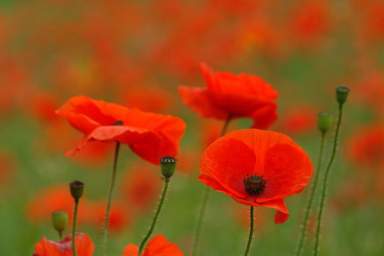


This is the final Poetry Friday devoted to poems of Remembrance. The first is Siegfried Sassoon's rather bitter, post-War poem:

Aftermath

Have you forgotten yet?...
For the world's events have rumbled on since those gagged days,
Like traffic checked a while at the crossing of city ways:
And the haunted gap in your mind has filled with thoughts that flow
Like clouds in the lit heavens of life; and you're a man reprieved to go,
Taking your peaceful share of Time, with joy to spare.
But the past is just the same-and War's a bloody game...
Have you forgotten yet?...
Look down, and swear by the slain of the War that you'll never forget.


Do you remember the dark months you held the sector at Mametz-
The nights you watched and wired and dug and piled sandbags on parapets?
Do you remember the rats; and the stench
Of corpses rotting in front of the front-line trench-
And dawn coming, dirty-white, and chill with a hopeless rain?
Do you ever stop and ask, 'Is it all going to happen again?'

Do you remember that hour of din before the attack-
And the anger, the blind compassion that seized and shook you then
As you peered at the doomed and haggard faces of your men?
Do you remember the stretcher-cases lurching back
With dying eyes and lolling heads-those ashen-grey
Masks of the lads who once were keen and kind and gay?

Have you forgotten yet?...
Look up, and swear by the slain of the war that you'll never forget!


March 1919.


Carola Oman was seventeen when the First World War began and, on leaving school at eighteen, she joined the Voluntary Aid Detachment as a nurse, serving on the Western Front from 1916 to 1919. The majority of the poems in her 1919 collection, The Menin Road and Other Poems, are documentary and elegiac in character, with many of them focused on methods of travel. The ship and the troop train, as agents of departure, are powerful symbols for many women war poets, with the movement of new recruits and soldiers on leave, or the transit of the wounded, providing a strong contrast to the troops entrenched in the stalemate of the Western Front.

The Lower Deck

Into the harbour now the boat has come.
                 They bawled for passports from the smoking-room.
Darkness upon the lower deck lay dumb
                 While a few elbowed through the crowded gloom.

The canvas flapped, and a blank face or two
                 Fathomed a laugh; till through the silence came
A thresh of waters; and thick blackness drew
                 Away . . . and a bright boat passed like a flame.

Rowdy music, song and shout,
'It's the leave-boat goin' out
Passin' us they are,
Goin' 'ome,
Goin' 'ome'. . . .

The murmur drifted like a dream
Mouth to mouth - - a sudden gleam - -
Till the voices died afar,
                 Till the thresh of waters drowned
All the sounds to a single Sound.

Boat passed boat. And then again
Came sudden vision, splendid pain.
These were my sons. Ah, who shall know
Into what night I watched them go,
How each blank face was dear to me,
How kindly fell the evening rain ?
And I could see - - and I could see.


Night Duty at the Station

                                   I

Slowly out of the siding the troop train draws away,
Into the dark it passes, heaving straining.
Shattering on the points the engine stutters.
Fires burn in every truck. Rich shadows play
Over the vivid faces . . . bunched figures. Some one mutters
'Rainin' again . . . it's raining.'
Slammings - a few shouts - quicker
Each truck the same moves on.
Weary rain eddies after
Drifts where the deep fires flicker.
Into the dark with laughter
The last truck wags . . . it is gone.


                                   II

Horns that sound in the night when very few are keeping
Unwilling vigil, and the moonlit air
Is chill, and everything around is sleeping -
Horns that call on a long low note - oh, where
Were you calling me last ?
The ghastly huntsman hunts no more, they say
The Arcadian fields are drugged with blood and clay
And is Romance not past ?


                                   III

The station in this watch seems full of ghosts.
Above revolves an opalescent lift
Of smoke and moonlight in the roof. And hosts
Of pallid refugees and children, shift
About the barriers in a ceaseless drift.
Forms sleeping crowd beneath the rifle-rack,
Upon the bookstall, in the carts. They seem
All to be grey and burdened. Blue and black,
Khaki and red, are blended, as a dream
Into eternal grey, and from the back
They stagger from this darkness into light
And move and shout
And sing a little, and move on and out
Unready, and again, into the night.


                                   IV

The windows in the Post Office are lit with olive gold.
Across the bridge serene and old
White barges beyond count
Lie down the cold canal
Where the last shadows fall;
And a transparent city shines upon a magic mount.

Now fired with turkis blue and green
Where the first sunshine plays
The dawn tiptoes between
Waiting her signal from the woodland ways. . . .

Friday, November 17, 2006

Poetry Friday 24: Remembrance 3


I am continuing my theme for November of poems for Remembrance and would like to offer you the following poems.

Battalion-Relief

(from Counter-Attack and other Poems)

'Fall in! Now get a move on.' (Curse the rain.)
We splash away along the straggling village,
Out to the flat rich country, green with June...
And sunset flares across wet crops and tillage,
Blazing with splendour-patches. (Harvest soon,
Up in the Line.) 'Perhaps the War'll be done
'By Christmas-Day. Keep smiling then, old son.'

Here's the Canal: it's dusk; we cross the bridge.
'Lead on there, by platoons.' (The Line's a-glare
With shell-fire through the poplars; distant rattle
Of rifles and machine-guns.) 'Fritz is there!
'Christ, ain't it lively, Sergeant? Is't a battle?'
More rain: the lightning blinks, and thunder rumbles.
'There's over-head artillery!' some chap grumbles.

What's all this mob at the cross-roads? Where are the guides?...
'Lead on with number One.' And off they go.
'Three minute intervals.' (Poor blundering files,
Sweating and blindly burdened; who's to know
If death will catch them in those two dark miles?)
More rain. 'Lead on, Head-quarters.' (That's the lot.)
'Who's that?... Oh, Sergeant-Major, don't get shot!
'And tell me, have we won this war or not?'


Siegfried Sassoon


The next two poems are by one of the women poets of the First World War, Helen Hamilton. Her poems have much in common with Sassoon's, for all she did not experience life in the Front Lines. Little appears to be known about Helen Hamilton, beyond the fact that she was a school teacher. Her poetry, wryly observed and sharply satirical, may be compared without detriment to that of Sassoon - most of her poems are about the hypocrisy of those At Home, who were one of Sassoon's targets in his satirical poems. Her poem 'The Ghouls' is reminiscent of many poems by trench poets in its condemnation of the old men left At Home, but it also has a strong, anti-patriarchal note. The other civilians whom Hamilton attacks ferociously are the women who organised mass recruitment meetings prior to the introduction of conscription in May 1916 and who also handed out white feathers to young men who were not in uniform. In 'The Jingo-Woman', Hamilton not only attacks these women, but defends the young men, pointing out that it is easy for women to attack men for not enlisting when women are not called on to fight themselves.


The Ghouls

You strange old ghouls,
Who gloat with dulled old eyes,
                  Over those lists,
                  Those dreadful lists,
                  To see what name
                  Of friend, relation,
                  However distant,
                  May be appended
To your private Roll of Honour.
Unknowingly you draw, it seems,
                  From their young bodies,
                  Dead young bodies,
                  Fresh life,
                  New value,
Now that yours are ebbing.
                  You strange old ghouls,
Who gloat with dulled old eyes,
                  Over those lists,
                  Those dreadful lists,
                  Of young men dead.


The Jingo-Woman

Jingo-woman
(How I dislike you !)
Dealer in white feather,
Insulter, self-appointed,
Of all the men you meet,
Not dressed in uniform,
When to your mind,
                  (A sorry mind),
                  They should be,
                  The test ?
The judgement of your eye,
That wild, infuriate eye,
Whose glance, so you declare,
                  Reveals unerringly,
Who's good for military service.
Oh ! exasperating woman,
I'd like to wring your neck,
                  I really would !
                  You make all women seem such duffers !
                  Besides exemptions,
                  Enforced and held reluctantly,
                  -Not that you'll believe it -
                  You must know surely
Men there are, and young men too,
Physically not fit to serve,
Who look in their civilian garb
                  Quite stout and hearty.
And most of whom, I'll wager,
Have been rejected several times.
How keen, though, your delight,
                  Keen and malignant,
Should one offer you his seat,
                  In crowded bus or train,
Thus giving you the chance to say,
In cold, incisive tones of scorn:
                  'No I much prefer to stand
                  As you, young man, are not in khaki !'
Heavens ! I wonder you're alive !
                  Oh, these men,
These twice-insulted men,
                  What iron self-control they show,
                  What wonderful forbearance !

But still the day may come
For you to prove yourself
As sacrificial as upbraiding.
So far they are not taking us
But if the war goes on much longer
                  They might,
                  Nay more,
                  They must,
When the last man has gone.
And if and when that dark day dawns,
You'll join up first, of course,
Without waiting to be fetched.
But in the meantime,
Do hold your tongue !
You shame us women.
Can't you see it isn't decent,
To flout and goad men into doing,
                  What is not asked of you ?


Both of these poems appear in Catherine Reilly's excellent collection of WW1 poetry by women poets, Scars Upon My Heart. You will find the poems by Sassoon which I have quoted in his collected War Poems.
Friday, November 10, 2006

Poetry Friday 23: Remembrance 2


Continuing my theme for November of poems for Remembrance, I'd like to offer the following poems.

Break of Day in the Trenches

The darkness crumbles away.
It is the same old druid Time as ever,
Only a live thing leaps my hand,
A queer sardonic rat,
As I pull the parapet's poppy
To stick behind my ear.
Droll rat, they would shoot you if they knew
Your cosmopolitan sympathies.
Now you have touched this English hand
You will do the same to a German
Soon, no doubt, if it be your pleasure
To cross the sleeping green between.
It seems you inwardly grin as you pass
Strong eyes, fine limbs, haughty athletes,
Less chanced than you for life,
Bonds to the whims of murder,
Sprawled in the bowels of the earth,
The torn fields of France.
What do you see in our eyes
At the shrieking iron and flame
Hurled through still heavens ?
What quaver - what heart aghast?
Poppies whose roots are in man's veins
Drop, and are ever dropping;
But mine in my ear is safe -
Just a little white with the dust.


- Isaac Rosenberg


Isaac Rosenberg was the least privileged of the British First World War poets. He was born in 1890, into a working-class Jewish family which had emigrated from Russia and eventually moved to the East End of London. Although Rosenberg's working-class origins and financial circumstances prevented him from attending either Oxford or Cambridge University, he was a talented artist and enrolled in evening classes at the Art School of Birkbeck College, part of London University. He hoped to make a living as a portrait artist and had moved to South Africa to pursue his career when the First World War broke out. He returned to England in 1915, enlisted in 1916, and was killed at the front on April 3, 1918.


The Rear-Guard (Hindeburg Line, April 1917)

(from Counter-Attack and Other Poems)

Groping along the tunnel, step by step,
He winked his prying torch with patching glare
From side to side, and sniffed the unwholesome air.

Tins, boxes, bottles, shapes too vague to know;
A mirror smashed, the mattress from a bed;
And he, exploring fifty feet below
The rosy gloom of battle overhead.

Tripping, he grabbed the wall; saw some one lie
Humped at his feet, half-hidden by a rug,
And stooped to give the sleeper's arm a tug.
'I'm looking for headquarters.' No reply.
'God blast your neck!' (For days he'd had no sleep,)
'Get up and guide me through this stinking place.'

Savage, he kicked a soft, unanswering heap,
And flashed his beam across the livid face
Terribly glaring up, whose eyes yet wore
Agony dying hard ten days before;
And fists of fingers clutched a blackening wound.

Alone he staggered on until he found
Dawn's ghost that filtered down a shafted stair
To the dazed, muttering creatures underground
Who hear the boom of shells in muffled sound.
At last, with sweat of horror in his hair,
He climbed through darkness to the twilight air,
Unloading hell behind him step by step.


- Siegfried Sassoon


Siegfried Sassoon was born at the family home of Weirleigh in Matfield, Kent, in 1886. He was the second son of Alfred and Theresa (née Thornycroft), who subsequently separated when Sassoon was just five years old. Alfred had been disowned by his mother on his marriage to Theresa because she was not a Jew, and Alfred was the first of the Sassoon clan to marry outside the family faith. Alfred died of TB when Sassoon was nine. Siegfried was educated at Marlborough College (a private boarding school in Wiltshire), then at Clare College, Cambridge. He studied both Law and History at Cambridge, before leaving without taking a degree. After he left Cambridge, Sassoon lived the life of a sportsman, hunting, riding point-to-point races and playing cricket until the outbreak of the First World War. He enlisted on 2 August 1914, two days before the British declaration of war, and initially joined up as a trooper in the Sussex Yeomanry. However, after a riding accident whilst doing some field-work (he had put his horse at a fence blind with summer vegetation, and a hidden strand of wire brought the horse down on top of him, leaving Sassoon with a badly broken right arm), Sassoon was commissioned in the Royal Welch Fusiliers in May 1915. Between November 1915 and April 1917 he served as a second lieutenant in both the First and Second Battalions, Royal Welch Fusiliers. (There's a longer version of this biography on my Counter-Attack website.)

Friday, November 03, 2006

Poetry Friday 22: Remembrance 1


Since this year is the 90th anniversary of the Battle of the Somme, I'm devoting November to Remembrance and will be posting poems of the First World War. I shall start with two by my favourite WW1 poet, Siegfried Sassoon.

Attack

(from The Old Huntsman)

At dawn the ridge emerges massed and dun
In the wild purple of the glow'ring sun,
Smouldering through spouts of drifting smoke that shroud
The menacing scarred slope; and, one by one,
Tanks creep and topple forward to the wire.
The barrage roars and lifts. Then, clumsily bowed
With bombs and guns and shovels and battle-gear,
Men jostle and climb to meet the bristling fire.
Lines of grey, muttering faces, masked with fear,
They leave their trenches, going over the top,
While time ticks blank and busy on their wrists,
And hope, with furtive eyes and grappling fists,
Flounders in mud. O Jesus, make it stop!


Does it Matter?

(from Counter-Attack and other Poems)

Does it matter? - losing your legs?...
For people will always be kind,
And you need not show that you mind
When the others come in after hunting
To gobble their muffins and eggs.

Does it matter? - losing your sight?...
There's such splendid work for the blind;
And people will always be kind,
As you sit on the terrace remembering
And turning your face to the light.

Do they matter? - those dreams from the pit?...
You can drink and forget and be glad,
And people won't say that you're mad;
For they'll know you've fought for your country
And no one will worry a bit.